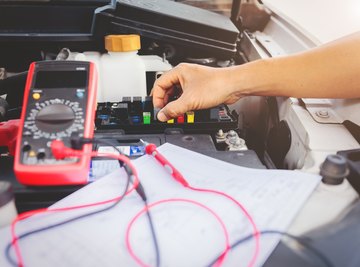

Amperage is a term to describe the flow rate of electrical current. It is measured in amperes (amps). To find what amperage your alternator is, you must first understand the relationship between volts and amps. Volts are the capacity of a given electrical current, and amps are the current's power. If you don’t have enough volts, it could cause serious and permanent damage to your car. Without enough electrical current, various components may starve and burnout.
Have a mechanic use an ammeter to test your amps.
Alternators generally have four parts: a rotor, stator, rectifier, and regulator. Alternating current (AC) is made by the stator and rotor (AC is what happens when mechanical energy changes to electrical energy.). It is sent to the battery producing voltage that powers your lights, for example.
Fuses are devices that protect electrical circuits.
Avoid electrical hazard. Take either your car or car alternator to a professional.
Consider the size and placement of your particular alternator. It will help you narrow down the numerical possibilities. Alternators vary dramatically in size and appearance. For example, some cars have regulators (a common alternator part) mounted outside the alternator body that may cause variation in amperage usage. The size of an alternator will most likely increase the set amperage, too. High output alternators (often found on larger vehicles) can use between 200 to 350 amps. Smaller cars by comparison, such as a Ford Mustang, will only use about 100 amps with batteries that run at about 12 volts.
Determine the fuse ratings of your car’s electrical components. You can estimate what amperage your alternator runs at this way. Look for a diagram under or near your fuse box cover. It will have individual amperage numbers (sometimes along with volts) already set by the manufacturer. Add up those numbers to find what amperage your alternator needs to feed the car’s electrical system. Verify this number with the part manufacturer, if necessary.
Use a formula to calculate your amperage. For example, if you have a component (in this case, an alternator) that needs a certain amount of watts (also known as “volt amp load”) to work, you need to set that as a mathematical variable. Most common equations use “I” to indicate amperage.
Set your watts math variable at VA (for volt amp), then divide the two former variables by your volts or “V.” The equations will look like this: I=VA/V (Amperage=watts/volts). Check your alternator specification guide or contact the alternator manufacturer, if you do not see the numbers of watts written on the alternator. An example equation for a basic amperage number may look like this: I=1200/12 (Answer: 100 amps).
Tips
Warnings
References
Tips
- Have a mechanic use an ammeter to test your amps.
- Alternators generally have four parts: a rotor, stator, rectifier, and regulator. Alternating current (AC) is made by the stator and rotor (AC is what happens when mechanical energy changes to electrical energy.). It is sent to the battery producing voltage that powers your lights, for example.
- Fuses are devices that protect electrical circuits.
Warnings
- Avoid electrical hazard. Take either your car or car alternator to a professional.
About the Author
Vaughnlea Leonard started her professional writing and editing career in 2005. Her work has appeared in "Press Journal," "Atlantic Publishing Company" and "Hometown News and Florida Today." A former military police enlistee and Florida certified educator, she obtained a Bachelor of Arts in English from the University of Central Florida.