
Fun Softball Team Drills
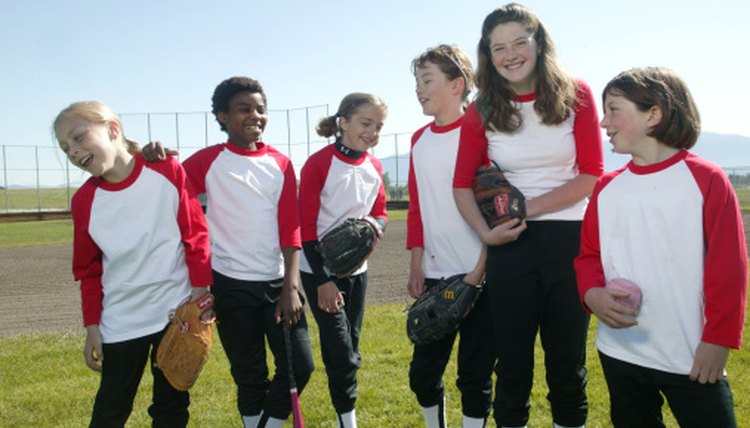
As a softball coach, your job is to teach your players the subtle strategies of the game, proper technique and to help them perfect their skills. One of your many challenges is to keep your players motivated and engaged during practice. What may help is to run a variety of fun, team drills. To get the most out of players, split the practice into two halves. For the first half, run several high-energy, skill-specific team drills. During the second half, have your players scrimmage while you occasionally stop and show them how the drills would apply to specific situations.
Bounce in Front
Hitting an object other than a softball is a fun way to change things up in practice while working on batting skills, according to SoftballPerformance.com. The bounce in front drill allows two players to work on the timing of their hitting. One player is designated as the hitter while the other is the bouncer. The hitter lines up at home plate, just as she would normally in a game. The bouncer stands about three feet in front and six feet to one side of the hitter. The bouncer then bounces a tennis ball in the direction of the hitter. The hitter must allow the ball to bounce in front of the plate before swinging at the ball.
Two-Ball Drill
With this drill your players can improve their quickness as a batter and learn to hit the ball to different parts of the field. Have each player warm up by hitting a minimum of 10 pitches in the cage before starting the drill. During the drill, the batter stands in the batter's box while you stand to the side. Toss two balls, each a different color, to your batter simultaneously. Yell out a color and the batter must hit the corresponding ball. This improves split-second decision-making, hand-eye coordination and overall quickness. Have each batter take about 15 swings.
Infield Hustle
Getting your team moving with the infield hustle drill will improve their throwing and fielding skills. First, separate your players into four groups and line them up at each of the bases and the shortstop position. Hit a ground ball to the player at third base and have her throw the ball as accurately as possible to the player at first base. After she throws the ball, have her run to the back of the shortstop line. Immediately after hitting the ball to third base, hit another one to the player in front of the line at shortstop and a third ball to the player in front of the second base line. Have these players accurately throw the ball to first base and move to the line that is located to their left. After the player at first base has taken the throw from the player at second, hit a ball to the player lined up at first. Players are eliminated when they have committed three throwing or fielding errors.
Writer Bio
Kristin Davis has been writing since 2004, specializing in the health and fitness fields. She has written for online and print publications including Fitness Monthly and Creative Circle. Davis has certification through the International Fitness Professionals Association as a personal trainer.