

How to Repair a Water Pipe in a Mobile Home

Plumbing in a mobile home is somewhat more susceptible to breaking and leaking than the plumbing in a “site-built” house. Expense and flexibility dictate the use of plastic pipe material rather than the copper tubing often installed in a stationary structure.
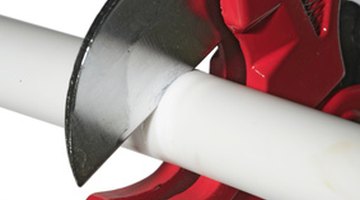
Newer mobile homes have cross-linked polyethylene or PEX pipe. Replacement piping, quick-connect (also called push-to-connect) couplings and specialized tools are available at any home improvement store. The water pressure itself holds the quick-connect couplings together, making a secure connection.
Things You Will Need
- Water supply shut-off wrench
- Pipe cutter
- Pencil
- Gloves
- Tape measure
Removing the Broken Pipe Section
-
Place the U-shaped fitting of the water supply shut-off wrench over the flange on the shut-off valve of the water supply meter. Twist the wrench until the water stops flowing.
-
Locate the source of the leak. If it is under the home, the pipe may be covered by the under-floor insulation. Slice the insulation open with a knife or other sharp tool. Try not to slash the insulation more than necessary. You’ll need as much of it intact as possible to replace after the job.
-
Pull the pipe away from the insulation. Cut the section with the leak (or leaks) out of the broken pipe with the pipe cutter. Be sure the cut is clean and smooth.
-
Go to a home improvement or hardware store and purchase pipe and couplings. Most mobile home potable (drinkable) water piping is 1/2 inch, but to be sure, take the pipe section to the store and shop for the correct-sized replacement pipe and couplings.
Installing the New Pipe Section
-
Trim the ends of both the old and new pipes with the pipe cutter so that all the pipe ends are smooth and straight. Be sure you leave enough length that the pipes can be fitted together easily without bending too much or crimping. Include the length of the coupling in your estimation.
-
Measure the length from the end of the fitting to the measurement line and mark that length on the pipe with a pencil.
-
Insert the PEX pipe insert into one end of the new pipe. Firmly push the pipe into the coupling up to the pencil marking. Repeat this for each end of the new pipe section.
-
Insert PEX pipe inserts on each end of the old pipe. Firmly push the coupling on the replacement pipe into one end of the old pipe until it creates a snug connection.
-
Push the remaining replacement pipe coupling onto the coupling on the old pipe. Check to be sure that all connections are snug and that the repaired section has no crimps.
-
Turn the water on slowly at the water supply valve. Check for any leaks or areas of strain. Ease the repaired section back up under the insulation.
-
Wait several hours for the insulation to dry then seal the opening in the insulation with duct tape.
Tip
There are other methods for attaching couplings, but they are more expensive, require expensive tools and may not hold as securely. If you have the old, gray polybutylene pipe, you may want to replace all the potable water lines under your home with PEX pipe. Polybutylene will likely eventually develop leaks, and you will end up replacing long sections of the pipe 6 inches at a time.
Warning
PEX pipe deteriorates very quickly in direct sunlight. Do not install or store it in direct sunlight.
Many older homes had polybutylene (PB) pipe, which was prone to leaks and breaks. Manufacturers of the PB pipe settled several lawsuits as a result of these problems. Unfortunately, those suits are now closed.
The Drip Cap
- Plumbing in a mobile home is somewhat more susceptible to breaking and leaking than the plumbing in a “site-built” house.
- Newer mobile homes have cross-linked polyethylene or PEX pipe.
- Place the U-shaped fitting of the water supply shut-off wrench over the flange on the shut-off valve of the water supply meter.
- Pull the pipe away from the insulation.
- Most mobile home potable (drinkable) water piping is 1/2 inch, but to be sure, take the pipe section to the store and shop for the correct-sized replacement pipe and couplings.
- Insert the PEX pipe insert into one end of the new pipe.
- Check for any leaks or areas of strain.
References
Resources
Writer Bio
Dee Shneiderman, former librarian and paralegal, has been writing for 40+ years. Published in Compute! Magazine, she helped found The Crescent Review literary magazine. Owner of Frugal-Foto Photography, she holds a Bachelor of Arts in English, a Master of Library Science and a North Carolina Truck Driver Training certificate.
Photo Credits
- scissor cut white plastic pipe image by Graf_es from Fotolia.com
- scissor cut white plastic pipe image by Graf_es from Fotolia.com
More Articles

