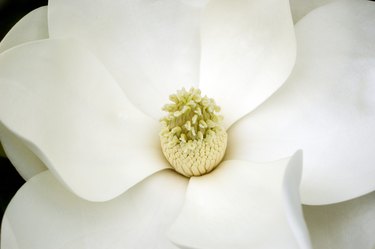
Growing magnolia (Magnolia spp.) from seed can be done, however it should only be done with standard species. Hybrids and cultivars are problematic because they are a cross between two or more species, causing their seeds to grow with traits of the parents rather than the hybrid. Southern magnolia (Magnolia grandiflora), a standard species that grows year round in U.S. Department of Agriculture plant hardiness zones 7 to 10 is a good choice for growing from seed. Seeds can be direct seeded into the ground, but squirrels dig them up and eat them, so start seeds in trays then transplant to the garden.
Gather
Video of the Day
In late summer, southern magnolia's seed-filled cones fall to the ground; gather several and lay them on a table to dry for about one week. When the dried cones open, dig out the seeds and remove their bright red seed coats with your fingers. The coat should slip off easily, exposing a black seed. If the coat does not come off, soak seeds in water overnight. Wipe away any jellylike pulp with a towel, then scarify the black seed with coarse sandpaper just enough to penetrate the outer oils on the seed; this promotes germination.
Video of the Day
Chill
For magnolia seeds to germinate, they need to undergo a period of chilling. Chill scarified seeds in a zip-style plastic bag, add a layer of seed followed by an equal amount of potting soil. Continue layering seeds and soil, ending with a layer of soil. The potting soil should be moist, but not soaked. Close the bag tightly, label it with the date and place in a refrigerator set between 40 to 45 degrees Fahrenheit. The sealed bag should retain moisture, but check every two weeks for signs of drying out; if soil is dry, wet it by spritzing. Store seeds in fridge until outdoor temperature warms to 70 degrees Fahrenheit, but not less than three months, then remove bag and plant seeds in trays for germination.
Germinate
Once seeds are chilled, and outdoor air temperature has warmed to 70 degrees Fahrenheit, fill a six-cell seed tray with seed starter mix. Poke a hole in each cell 1/2-inch deep with your finger. Place one seed in each hole, cover with soil, and water to thoroughly moisten soil. Push a wooden skewer into one cell then place the tray in a large zip-style bag and seal completely. The skewer holds the bag up, while the bag holds in moisture keeping the seeds wet until they germinate. To prevent cooking the seeds, place the bag in bright, but not direct sunlight. Seeds take several weeks to germinate. When seeds sprout and have at least two sets of leaves, open the bag and allow seedlings to acclimate to the air temperature for three to four days, then gradually move them into the sun to harden off. Seedlings can be moved to larger pots, or planted in the ground.
Plant
When seedlings are ready to be transplanted to the garden, plant each in an area with enough space to allow it to reach a maximum height of 80 feet and up to 40 feet wide. Southern magnolia does well in most soil types as long as it is loose and well-draining. For compact soils, amend with enough compost or grit to allow water to drain and not stand; work the soil until it is a fine texture. Dig a hole in the prepared bed twice the width as the rootball, and plant so the top of rootball is even with the ground. Seedlings need protection from direct sun the first year. Provide shade by driving four stakes into the ground around the seedling and stretching shade cloth of 40 to 50 percent density above the seedling; use lashing to secure the cloth. Water seedlings thoroughly and cover soil with 4 to 5 inches of mulch; keep mulch at least 3 inches from stem. For the first year, keep the soil moist; do not let it dry out.
- Oklahoma State University: Magnolias from Seed
- Texas A&M University: Southern Magnolia
- Today's Homeowner: How to Grow Magnolia Trees from Seed
- University of Florida IFAS Extension: Southern Magnolia
- University of Georgia Extension: Growing Southern Magnolia
- North Carolina State University: Overcoming Seed Dormancy: Trees and Shrubs
- Fine Gardening: Distinguishing Degrees of Light and Shade