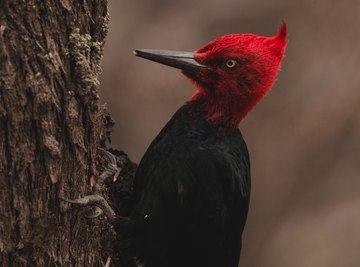
Whether you are out bird watching actively or just happen to spot a colorful bird while on a walk or a drive, the fun is knowing what bird you've just seen. A colorful red head might be a clue, but there are more than a few red-headed birds out there. Make sure you've spotted the correct one based on habitat, size and other characteristics.
Woodpeckers
Probably the most recognizable of the red-headed birds at first glance is the red-headed woodpecker. Woody the Woodpecker was this variety of bird, although woodpeckers in the wild generally don't have as pronounced a tuft.
They are found throughout North America and can be spotted not only by their red heads, but also by the white breast and black-and-white wings. They can be found doing what they do best, pecking trees.
Another red-headed bird of the woodpecker variety is the red-bellied woodpecker. While the red-headed woodpecker has a completely red head and neck, the red-bellied woodpecker has a red streak starting at the beak. The wings are also black and white but with a distinct pattern, like a zebra. Contrary to the name, the bellies of these birds are light beige or off-white. They can also be found throughout North America.
Yet another type of woodpecker is the lesser golden-backed woodpecker, also known as the black-rumped flameback, which can be found in South Asia. They are large birds with red Mohawks, golden wings and black-and-white bellies.
Northern Cardinal
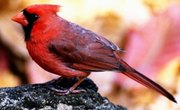
The northern cardinal not only has a red head, but is completely red except for a mask-type mark over the face. They are found throughout the continent of North America. If you spot a bright red cardinal, you've spotted a male. Females are a dull reddish-brown shade. Cardinals are medium in size and will feed in backyard feeders often.
Cherry-Headed Conure
This conure, also known as the red-masked conure, is a brightly colored bird with a bright red head and bright green body. They are found in western Ecuador and Peru in the wild but are also kept as family pets. These small birds are part of the parrot family and can learn to talk, with limited vocabulary.
Redpolls
There are two types of redpolls, each with red caps on the head: the common redpoll and the Arctic redpoll. Both these birds are in the finch family and both stay in habitats with shrubs and thickets. The common redpoll, found in North America, Europe and Asia, is surprisingly resilient to cold temperatures but migrates south in the winter to find food.
The Arctic redpoll is found in Greenland and Canada and tends to stay north throughout the winter, although some migrate short distances south.
Tanagers
There are two types of tanagers, the summer tanager and the scarlet tanager, which are both in the same family as the cardinal. In fact, the summer tanager looks almost identical to a cardinal minus the black mask over its face. These tanagers can be found throughout the U.S. and also when they migrate to Mexico and Central America.
The scarlet tanager also looks similar to the cardinal and summer tanager but has a stout beak. Their coloring is all red, but they have jet-black tails and wings. They are found in the same areas as the summer variety.
References
Resources
About the Author
Laila Alvarez has been writing professionally since 2002. She has written for Houston Community Newspapers and "L.A. Zoo View," "North O.C. Magazine," "Perpetual Phlegm" and other magazines, newspapers and websites. Alvarez has a Bachelor of Arts in journalism from California State University-Fullerton.