

How to Build an 8' X 4' Deck

Deck building can be quite strenuous work. lf you prepare before the job by choosing the location as well as listing materials, choosing wood types, etc., the process shouldn't create too many headaches.
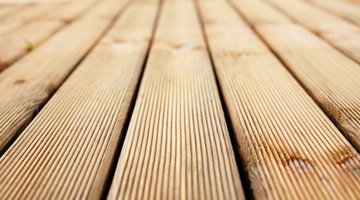
Things You Will Need
- Tape measure
- String
- 1 by 2 inch stakes (18 inches long)
- Hammer
- Spade
- Ready-mix cement
- Pencil
- Lumber (various sizes)
- 1/2 inch by 5 inch bolts
- 12 inch by 6 inch bolts
- Post-to-beam connectors
- 16d galvanized nails
- Box of galvanized 1 1/2 inch nails
- Metal joist connectors
- Deck screws
- Power drill
More so, though taxing, it should be a pleasure to build, as well as afterward being able to say that you built your own recreational area.
Mark Out The Deck Location
-
Mark out on the ground an area 8 feet by 4 feet in the desired deck location. You can use marking paint or the more conventional 1 by 2 inch stakes and string (use 18 to 24 inch long stakes). This area marks the perimeter for the deck.
-
Dig a hole 12 by 12 by 12 inches at each corner for the footings, making sure that the corners of the 8-by-12 foot area are at the center of each square. Mix ready-mix cement and pour into each hole. After they have set, place a pre-cast pier on the center of each footing. Cement mix can be used to permanently attach the pier to the footing. Cut 4 vertical posts to equal length (either 4-by-4 inch or 4-by-6 inch can be used) at the required height, and fit into the piers: drill 1/2 inch holes into the wood to connect the wood to the pre-cast pier metal post anchors, and secure with 1/2 inch by 5 inch bolts. Install two braces on each four sides in a "criss-cross" fashion to strengthen the structure: use 2-by-6 inch lumber for the braces, and 1/2 inch by 6 inch bolts (drill through both the 2-by-6 inch lumber and vertical post, connecting together with the bolt).
-
Fasten a post-to-beam connector to the top of each vertical post with 16d galvanized nails. Place cross beams (can be 4-by-6, 4-by-8 or 4-by-10 inches wide) into the connectors, one cross beam at the front of the deck, and one at the back. The cross beams should be parallel with each other. Connect the beams to the post-to-beam connectors with 16d nails.
-
Mark from one end of one cross beam every 16 or 24 inches (depending on local codes). Do the same with the other beam. Position the joists on the 16 or 24 inch markings so that the joists stand up and are both parallel with each other and perpendicular to the two cross beams. Connect every joist at both ends to the cross beams with metal joist connectors and 1 1/2 inch galvanized nails. Install blocking between the joists that may be required by code. Place rim joists over the two joist ends, with 16d nails.
-
Place the deck boards on top of, and at 90 degrees to the joists. Be sure that all deck boards are parallel with each other, and are spaced at least 1/8 inch apart. The end of one deck board and beginning of the next should be centered over a joist. Make sure the deck board ends are staggered so they don't line up: This will add to the aesthetics, as well as strengthen the deck. Use two deck screws to connect each deck board to the joist beneath it.
-
Install the railings (if the deck is high off the ground) by connecting 4-by-4 inch posts vertically to each corner of the deck, bolting them to the outer joists. Extra 4-by-4 posts may need to be installed in the middle of the outer joists, for added support (or to comply with local codes). Cut top rails to size (usually 2-by-6 lumber) and connect to the top of the vertical posts with nails. Sub-railings should also be installed as well as other wood, depending on your personal design. Paint or stain the deck, to protect it from the weather.
Tip
Hot dipped galvanized nails (about 1 1/2 inches long) are usually used when working with metal joist connectors, and are purchased in small or large boxes. Design your deck first before starting construction. Choose a type of wood to build your deck: Douglas fir, redwood and cedar are common choices. Check local codes for possible restrictions. The vertical posts connected to the footings (either 4-by-4 or 4-by-6 inch) should be pressure-treated wood, which prevents rotting from earth-to-wood contact. If your deck is high off the ground, check local codes for the possible need for larger footings. Blockings are simply pieces of wood placed between the joists to stop any possible bending. A rim joist simply covers up the ends of joists for a more aesthetic appeal. Deck screws should be of a good quality, and be either 2 1/2 or 3 inches long.
Warning
Check every measurement three times before cutting. This may save both money and time.
References
Tips
- Hot dipped galvanized nails (about 1 1/2 inches long) are usually used when working with metal joist connectors, and are purchased in small or large boxes.
- Design your deck first before starting construction.
- Choose a type of wood to build your deck: Douglas fir, redwood and cedar are common choices. Check local codes for possible restrictions.
- The vertical posts connected to the footings (either 4-by-4 or 4-by-6 inch) should be pressure-treated wood, which prevents rotting from earth-to-wood contact.
- If your deck is high off the ground, check local codes for the possible need for larger footings.
- Blockings are simply pieces of wood placed between the joists to stop any possible bending.
- A rim joist simply covers up the ends of joists for a more aesthetic appeal.
- Deck screws should be of a good quality, and be either 2 1/2 or 3 inches long.
Warnings
- Check every measurement three times before cutting. This may save both money and time.
Writer Bio
Steve Sloane started working as a freelance writer in 2007. He has written articles for various websites, using more than a decade of DIY experience to cover mostly construction-related topics. He also writes movie reviews for Inland SoCal. Sloane holds a Bachelor of Arts in creative writing and film theory from the University of California, Riverside.
Photo Credits
- Deck de madeira image by CarlosNeto from Fotolia.com
- Deck de madeira image by CarlosNeto from Fotolia.com
More Articles

