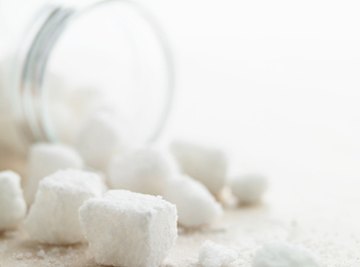

Sugar is a recipe ingredient, a coffee or tea sweetener, a staple of the candy industry and a substance that can be broken down very easily into glucose (the chemical molecule used by every living cell in nature as a nutrient). In its most common commercial manifestation, sugar is granulated, or in the form of grains, as is sand.
Sugar is perhaps above all a mainstay of cooking, both at the level of private kitchens and in heavy industry. This means that the molecule that sugar grains are made of, called sucrose. is often part of processes in which heating and cooling can play roles. This sugar sometimes participates in chemical reactions without your knowledge or explicit permission, and some of the results can be delectable.
What Is Ordinary Sugar Made Of?
"Sugar," in most everyday contexts, refers to the most common commercial product that bears that title, which goes by the chemical name sucrose.
Sucrose is a kind of sugar called a disaccharide, meaning it is composed of a pair of monosaccharides. Those monosaccharides are glucose and a very similar sugar called fructose that the body can rearrange into glucose with the help of biological enzyme protein catalysts.
Sucrose has the chemical formula C12H22O11. It is formed by dehydration synthesis, the removal of what ends up as a water molecule to join glucose and fructose, which both have the formula C6H12O6 but have different physical arrangements of their atoms (that is, they are stereoisomers).
What Is the Solubility of Sugar in Vinegar?
There is no appreciable sugar reaction with vinegar, which contains a dilute solution of acetic acid, CH3C=O(OH). Most white vinegar is about 5 percent acetic acid and about 95 percent water, so you can imagine how tart its taste might be without this dilution factor.
There is a difference between sugar dissolving and sugar breakdown, which reduces it to glucose and fructose molecules. This occurs as a result of hydrolysis, and is the opposite of the reaction described above that forms sucrose from its monosaccharide components. A water molecule is needed to round out the structures of glucose and fructose.
This non-dissolving of sugar and other molecules in vinegar is evident in food products such as Balsamic vinegar, which visibly contains sugar and other additives apart from any oil layer existing above the watery portion. Vinegar and sugar gastrique (a type of sweet and sour sauce used in cooking) is another such product.
Rock Candy: Precipitation of Sugar
When sugar is placed into plain water, for a time, it seems to disappear. This is because the grains of sugar dissolve, and the individual sucrose molecules become arranged in the spaces between water molecules. This is a result of the electrical polarity of water, which results in the breaking of the "bonds" between sucrose molecules resulting from intermolecular forces.
If enough sugar is added to the solution, no more can dissolve, and the solution is said to be saturated. If the mixture is heated, however, the solubility of sugar increases and more can be added. When the solution cools, the solubility decreases, and the solution is supersaturated.
Over a period of days, as the water evaporates, sugar crystals form, and if a string is placed in the container as a medium for growth, the result is the old favorite called rock candy.
Is There a Bleach and Sugar Reaction?
People are often tempted to combine household products such as bleach with everyday kitchen ingredients. In general, it is a bad idea to add anything organic (containing carbon) to bleach because even if the resulting reaction occurs slowly, an inevitable product of the reaction is chlorine gas.
This substance is extremely toxic and irritating to membranes. The take-home message is to not mess with bleach (sodium hypochlorite, or NaOCl) unless given specific and reliable directions and use adequate safety precautions.
References
About the Author
Kevin Beck holds a bachelor's degree in physics with minors in math and chemistry from the University of Vermont. Formerly with ScienceBlogs.com and the editor of "Run Strong," he has written for Runner's World, Men's Fitness, Competitor, and a variety of other publications. More about Kevin and links to his professional work can be found at www.kemibe.com.
Photo Credits
Lauren Burke/Lifesize/Getty Images