
How to Identify a Boeing 767
Carrying up to 300 passengers 6,000 to 7,000 miles in comfort and safety by using only two modern, turbofan jet engines, the 767 is the epitome of efficient air transportation.
- Difficulty:
- Moderately Easy
Instructions
Things You'll Need
- Film
- Cameras
- Internet Access
- Computers
- Camcorders
- Flying Lessons
- Internet Service Providers
- Camera Lenses
- SLR Camera
- Point-and-shoot Cameras
- Camera Accessories
- Camera Tripod
- Aircraft Band Scanner
- Air & Space Subscriptions
- Aviation Illustrated Magazine
- Flying Magazines
- Telescopes
-
-
1
Look for the 767 at major transportation hubs. The 767 is the aircraft used most often to cross the Atlantic Ocean.
-
2
Look for a twin jet engine aircraft.
-
3
Check to see that the engines are mounted on pylons under the wings, with a major portion of the engine itself resting ahead of the leading edge of the wing.
-
4
Note that the engines are modern turbofans - the intake is much larger in diameter than the exhaust.
-
5
Check the fuselage. The 767 is a "wide body," with two interior aisles for passengers.
-
6
Note that the fuselage is the same diameter from right behind the cockpit all the way to the tail of the 767.
-
7
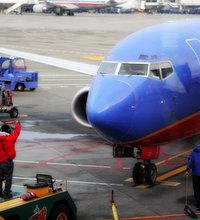
Look at the nose. It comes to a point along the centerline of the fuselage.
-
8
Look for a tall vertical stabilizer raked back at an approximately 45-degree angle.
-
9
Note that the 767 has a single passenger door in front of the wing, with an emergency exit mounted over the wing.
-
10
Remember, the 767-400 series is longer than the first three models of this aircraft.
-
1
Tips & Warnings
The standard model 767 is approximately 160 feet long. The Wright brothers' "Flyer," which made the first powered flight by a heavier-than-air machine, flew a distance of 120 feet.
Keep a camera handy, and remember to bring binoculars or a telescope when plane-watching.
Pilots qualify to fly the 757 and the 767 simultaneously because their "glass cockpits" - so nicknamed because of the plethora of video displays - are nearly identical.
Glass cockpits allow modern airliners to operate with only two pilots.
The 767 can be easily confused with the Boeing 757 and 777 or Airbus models. Plane-watchers should concentrate on minor details.
Use caution when plane-watching near airports.
Related Searches
Resources
Comments
-
Aug 25, 2006
A 767-200 has 1 over-wing exit. All others have 2 or none (767-400). Another thing to look for is main entry doors that open in and slide up. This is the same kind used on the l -1011. windows on a 767-400 are the same as the ones on a 777. -
Aug 25, 2006
A 767-200 has 1 over-wing exit. All others have 2 or none (767-400). Another thing to look for is main entry doors that open in and slide up. This is the same kind used on the l -1011. windows on a 767-400 are the same as the ones on a 777. -
Nov 22, 2005
The 767 also has two inboard ailerons that are around 4' wide. These are mounted on the rear of the wing, behind the engines. They move in conjunction with the outboard ailerons, and are frequently left offset while the aircraft is parked on the ground. Also, the 767 has two sets of main gear with 4 wheels each. This is similar to the 757, so look for the inboard ailerons. -
Nov 22, 2005
When airborne, the wheel trucks of the 757 and 767 are tilted. On the 757, the rear pair of wheels on the four wheel trucks are lower than the front, while on the 767, the front wheels are lower. The 777 wheel trucks have 6 wheels per truck.