

Hand Tools for Stone Breaking

Table of Contents
From hunting fossils to building stone walls, there are many reasons why you may need to break stones. Throughout history and still today, the most common approach to breaking stone is with the use of simple, handheld tools. Ensure a successful project by choosing the correct rock-breaking tool for the job.
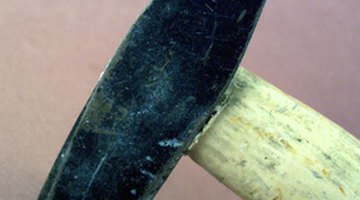
Three-pound Hammer
A 3-lb. hammer has a mallet-style head and is commonly used in conjunction with a strikeable chisel to break up flat rocks when building a stone wall. The heads are usually made of forged steel. If necessary, non-sparking brass hammers are also available. Three-lb. hammers used in geological applications are called crack hammers. A 3-lb. hammer is also used to break up large gemstones for rock tumbling.
Chisel
A stone chisel is a straight, round, metal tool with a flat, fin-shaped tip, which is moved along the score line of the stone while the back of the tool is tapped with the 3-lb. hammer to gradually break the stone. Stone chisels are also made with forged steel. Rock chisel sets are available which have multiple chisels with different tip styles.
Hatchet
Hatchets, which are like small, handheld axes, are also available for breaking stone and are used in a way similar to the chisel. The blade of the hatchet is placed along the score line and the back is tapped with the 3-lb. hammer. When breaking stones, whether it is with a chisel or a hatchet, work slowly and with light-pressure hammer taps to ensure a more controlled and even break.
Rock Hammer
Sometimes also called a rock pick, a rock hammer is shaped similar to a regular hammer except there is a chisel instead of a prying device on the opposite side of the hammerhead. The hammerhead and chisel are used in conjunction to carefully pick and excavate stone. A rock hammer is commonly used in geological applications.
Brick Hammer
Used by masons to break brick and to hammer nails, brick hammers are very similar to rock hammers, with a hammerhead on one side and a long, sharp chisel on the other.
Sledge Hammer
For excavating large chunks of rock or for demolishing certain stone structures, a sledge hammer is commonly used. Sledge hammers have added size and weight for striking more concentrated and heavy blows. Sledge hammers come in multiple weights, ranging from 4 to 16 lbs.
The Drip Cap
- From hunting fossils to building stone walls, there are many reasons why you may need to break stones.
- Throughout history and still today, the most common approach to breaking stone is with the use of simple, handheld tools.
- The heads are usually made of forged steel.
- hammer to gradually break the stone.
- Used by masons to break brick and to hammer nails, brick hammers are very similar to rock hammers, with a hammerhead on one side and a long, sharp chisel on the other.
References
Writer Bio
Mason Howard is an artist and writer in Minneapolis. Howard's work has been published in the "Creative Quarterly Journal of Art & Design" and "New American Paintings." He has also written for art exhibition catalogs and publications. Howard's recent writing includes covering popular culture, home improvement, cooking, health and fitness. He received his Master of Fine Arts from the University of Minnesota.
Photo Credits
- a hammer image by timur1970 from Fotolia.com
- a hammer image by timur1970 from Fotolia.com
More Articles

