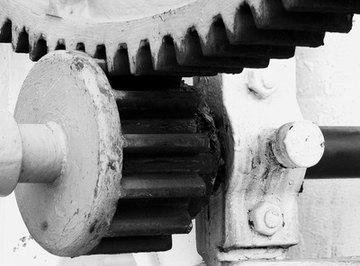
The most common type of gear is the spur gear. These gears have straight teeth and must be mounted on parallel shafts for their teeth to mesh with those of other gears. The disadvantage of spur gears is that they make a lot of noise when they are used at high speeds, and their design puts lots of stress on the gear teeth. For this reason, spur gears are known as slow speed gears.
Using Spur Gears For Power
Spur gears can be used to increase or decrease the torque, or power, of a given object. Spur gears are used to this effect in washing machines, blenders, clothes dryers, construction equipment, fuel pumps and mills. In power stations, so-called 'trains' of spur gears are used to convert a form of energy, such as wind or hydroelectric power, into electrical energy.
Using Spur Gears For Speed
Spur gears are also used to increase or decrease the speed of an object. For example, they are used in mechanical clocks to adjust the relative speeds of the second, minute and hour hands. In hand-held eggbeaters, spur gears are used to increase the speed of the eggbeater so it can be used more effectively.
Spur Gears and Cars
Spur gears are not used in cars because of the loud noise they produce at high speeds. The noise comes from the sound made when the teeth of the gears collide. Spur gears are, however, used in aircraft engines, where they are superior to helical gears, and where noise is not an issue.
References
About the Author
Sachiko Schott has been writing since 2001, and has been published in "Twilight Song," "Liaisons" and "Young Voices Magazine." She holds a Bachelor of Science degree in zoology from the University of Guelph.
Photo Credits
zahnrad image by Carina Hansen from Fotolia.com