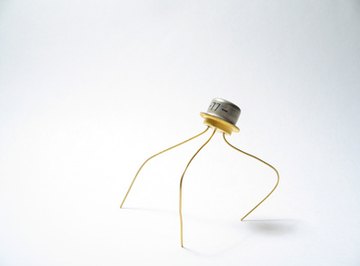

How to Use a 2N3055 Transistor

How to Use a 2N3055 Transistor thumbnail
One of the simplest uses for transistors is to provide switching functions.

When designing transistor circuits, the manufacturer's data sheet is an invaluable resource. The data sheet for the 2N303055 transistor indicates that this is an NPN transistor that can handle up to 15 amps of current and 60 volts. As such, it is useful for automotive switching applications. Unlike most of the accessories in your car, which are permanently connected to ground and switched by the positive power supply wire, an NPN transistor will work the opposite way. That is, the device to be controlled by the transistor is connected permanently to the +12 V supply and the ground side is switched. If this is acceptable for your application, then this transistor may be used.

Things You'll Need

  • Insulated wire
  • Soldering iron
  • Flux core solder
Show More

Instructions

    • 1

      Use the manufacture's data sheet to identify the base, emitter and collector connections on the transistor. If you are planning on switching a heavy load (five amps of higher), mount the transistor in an appropriate heat-sinking mount.

    • 2

      Use a suitable length of wire to solder the emitter of the transistor to an appropriate ground connection of the automobile.

    • 3

      Connect the base of the transistor to the control source signal responsible for operating the device. If you are using a transistor switch, it is because you are trying to control some load from a source that is incapable of driving it directly, such as a micro-controller project or other light electronic source. Note that since this is an NPN transistor, the source will have to provide a positive voltage to the base to switch the transistor on.

    • 4

      Connect the power side of the device to be controlled by the transistor directly to an appropriate supply voltage, and connect the ground side of the device to the collector of the transistor. Since the collector connection is direct to the case of the 2N3055, you will have to use a nut and bolt through the transistor's mounting hole and slip the wire under the nut before tightening it. The case of the transistor is not designed to be soldered, leaving this as the only proper option for connecting to it.

    • 5

      Test the circuit by having your controlling source provide power to the base of the transistor. The device being controlled by the transistor should now become active. When the control voltage is removed, the device should turn back off.

Tips & Warnings

  • According to the data sheet, the 2N3055 requires 1.5V on the base to turn it on and the current that will flow in the collector will be on the order of 100 times the base current. Therefore your controller will have to output at least 1.5V and must be able to supply at least 1 percent of whatever amount of current you are attempting to switch with the transistor.

  • For safety, always remember that the power source should be disconnected while performing any electrical connections to a vehicle.

Related Searches:

Resources

  • Photo Credit transistor image by Aleksandr Lukin from Fotolia.com

Comments

You May Also Like

  • How to Find the Legs on a 2N3055 NPN Transistor

    The 2N3055 NPN power transistor comes in a standard metal case, developed by the Joint Electron Device Engineering Council (JEDEC), called the...

  • How to Test a 2N3055 Transistor

    The 2N3055 transistor, like all transistors, is essentially an electronic switch. Because the 2N3055 is a bipolar junction transistor, its three terminals...

  • How to Test a TO-3 Power Transistor

    Transistors are used in amplifier and switch circuits. Depending on how much power the transistor is designed to dissipate, the transformer may...

  • How to Use an NPN Transistor

    An NPN transistor is a type of bipolar junction transistor. The letters "NPN" (negative-positive-negative) refer to the types of semiconductors inside the...

  • How to Make a Car Exhaust System Throw Flames

    Hot Rod enthusiasts in years past popularized exhaust systems that shot flames at the flip of a switch. State laws on such...

  • How to Use Transistors in Electronic Circuits

    A transistor uses a small voltage or current to direct the flow of a much larger current. A field-effect transistor uses an...

  • How to Check an NPN Transistor

    When an electronic circuit fails, it is not always readily apparent which component is to blame. If there are no obvious signs...

  • How to Network the HP 3055

    The HP LaserJet 3055 is an all-in-one printer that also features scanning and copying capabilities. This printer is geared toward the business...

  • How to Use Transistors as a Switch

    In addition to its normal use in linear mode as a signal amplifier, a transistor is also well-suited for use as a...

  • Ways to Layout Cascode Transistors

    Ways to Layout Cascode Transistors. A transistor is a common electronic component. It has three elements: the emitter, the collector or cathode...

  • How to Connect a PNP Transistor

    Transistors are solid-state devices that have changed the world. They eliminated bulky mechanical relays and unreliable vacuum tubes in almost all applications...

  • Explanation of Transistors

    As an invention that's helped shape modern society, the transistor ranks with the light bulb. First introduced in the 1940s, the transistor...

  • How to Decode Transistors

    Transistors fall into two basic designs--the PNP transistor or the NPN transistor--yet there are thousands of types. Each is made to affect...

  • How to Wire a PNP Transistor

    A transistor can act as both an amplifier and a switch. It has three semiconducting elements: the base, collector and emitter. Don't...

  • How to Connect a Switch to a 12V LED

    Voltages above 2 to 4 volts rapidly destroy LEDs unless a current-limiting resistor protects them. 12-volt LEDs consist of an LED and...

  • Use of Transistors

    In 1956, the Nobel Prize in Physics went to three American Physicists, Walter Houser Brattain, John Bardeen, and William Bradford Shockley. These...

  • How to Use Darlington Transistors

    In a transistor circuit, two transistors can be connected together to create a practical circuit called a 'Darlington pair'. When a Darlington...

  • How to Test Germanium Transistors

    Early solid-state electronic equipment made in the 1950s and '60s used germanium transistors. When electronics manufacturers perfected the silicon transistor, it soon...

  • How to Open an NPN Transistor

    Invented in 1947, the transistor is among the paramount inventions of the 20th century---found in nearly all electronics for its ability to...

  • What Is a Circuit Breaker Used For?

    Ensuring the safety of a home is crucial in maintaining a comfortable living environment. Electrical hazards can occur anytime, especially during a...

Related Ads

Featured