
How to Adjust Marker Ski Bindings
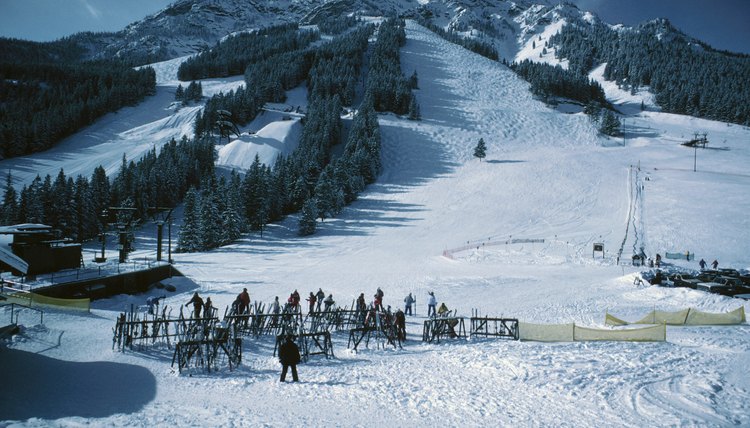
Ski bindings are an increasingly high-design piece of equipment and need to be adjusted to the proper tension setting (known as the "DIN" setting). Marker bindings also typically have a "fore aft" adjustment, which allows the binding to be moved slightly forward and backward to maximize ski performance. Each of these settings is critical to the safety and performance of a day on the slopes.
How to Adjust Marker Ski Bindings
Find a Marker DIN chart. The DIN setting adjusts the tension at which the binding releases the boot. A tight setting -- or high number -- is for aggressive skiers, while a lower setting is for beginners. The wrong setting means the ski could release unexpectedly or could not release when needed. Either could cause a bad crash. Technically, DIN settings are universal across all brands of bindings, but often an experienced skier will find they need different DIN settings for different brands of bindings. Marker publishes a manufacturer's DIN chart for its bindings, which helps eliminate guesswork. The Marker DIN chart is easy to find online.
Know your type of skiing. Be honest; if you ski slowly, you will need your bindings to release fairly easily if you fall -- otherwise you risk serious injury.
Set your DIN. On the Marker chart, find your height and weight. This will correspond to a letter code on the chart. If the height and weight letter code are different, use the one higher up on the chart as a starting point (if your height code is "L" and your weight code is "K," start with the K). Look across the chart for your boot length for a numerical DIN setting. If you are a "I" level skier -- or a beginner -- use that DIN setting. If you are a "II" level skier, use one number higher. So if the DIN setting in the boot length column was five, use five and a half or six as your DIN. If you are "III" level skier, go two DIN settings higher. Set the DIN using a screwdriver to adjust the screws in the front and back of the bindings.
Check the fore aft setting. Many Marker bindings are on "rails," meaning they can be loosened and moved up on the rails closer to the front of the ski, or slid back slightly. Depending on the binding, the fore aft setting might be controlled by screws in the heels and toes or by a locking device that can be unscrewed. Do not overextend this adjustment; Marker bindings have been known to release if the screw that controls the fore aft adjustment is backed out of its hole too far. It is best to read up online about your particular bindings if you are not familiar with the fore aft adjustment.
Check bindings every time you ski. Bindings can be loosened through use, so make sure they are at their correct setting each time you ski.
Tips
Internet forums for backcountry skiing are great resources for finding out more about your bindings. If you are having trouble understanding what is being discussed in these forum, you may want to consider taking your skis into a shop for adjustment. Many experienced skiers use the DIN setting in the Marker chart as a starting point and adapt it based on their own experience.
Warnings
Adjusting bindings is a serious job that could result in severe injury if done wrong. It is seemingly simple but really is a highly precise, skilled job. You need to understand ski geometry, forward pressure on the binding and what the release point on the rear of the binding.
Tips
- Internet forums for backcountry skiing are great resources for finding out more about your bindings. If you are having trouble understanding what is being discussed in these forum, you may want to consider taking your skis into a shop for adjustment. Many experienced skiers use the DIN setting in the Marker chart as a starting point and adapt it based on their own experience.
Warnings
- Adjusting bindings is a serious job that could result in severe injury if done wrong. It is seemingly simple but really is a highly precise, skilled job. You need to understand ski geometry, forward pressure on the binding and what the release point on the rear of the binding.
Writer Bio
Melanie Nozzolillo has been writing professionally since 1998 on a variety of topics including wellness, physical fitness, sustainable energy, sports, photography and film. She holds a Master of Fine Arts in film and media arts.