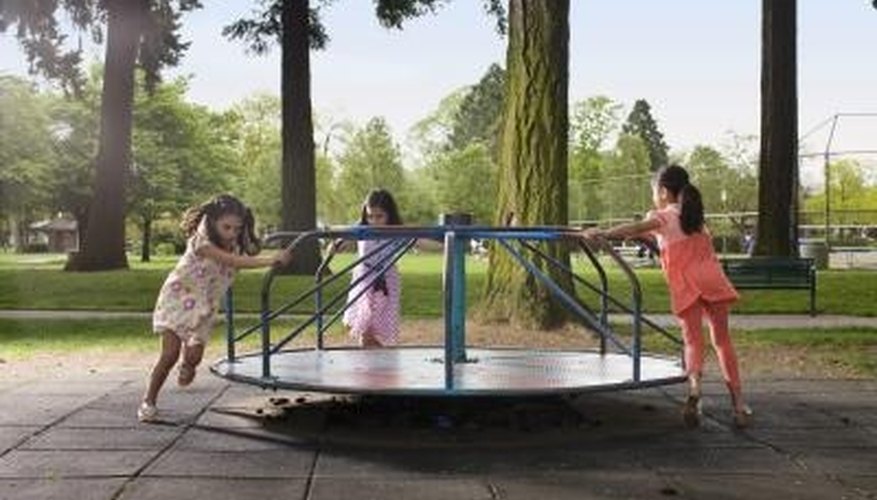


The kid in all of us remembers what it was like to spin yourself sick on the merry-go-round at the park. It was exhilarating to be able to watch the world swirling around you, speeding by faster than your brain could process. You can recapture those moments of youth in your own backyard, with little labor and some basic construction know-how.
Foundation
Your merry-go-round will need a solid foundation to support the weight of little ones. Dig a hole below the frost line and insert a length of thick galvanized pipe, long enough so that about 8 inches sticks above ground with the threads exposed at the end. Fill the hole with concrete, making sure the pipe is level and threaded at the top, and allow the concrete to set.
Platform Base
For the base of the platform you'll need a pair of brake rotors with holes in the center that match the size of the main pipe, a pipe union (a piece that joins two lengths of pipe together), and a 3 1/2-inch length of pipe. If you can find rotors with an eight-lug-nut pattern, that is ideal, but not necessary. Screw the union and the short pipe to the center pipe. Once the pipes are attached, slip one of the rotors over the top of the pipe to test its effectiveness. The rotor should rest 8 inches off the ground on the lip of the union, and have enough play to spin without sticking or rubbing excessively on the pipe.
Platform
From four sheets of the thickest pressure-treated plywood you can find (at least 1 inch), cut four semi-circles with a 3-foot radius. At the center of the semi-circle, cut another semi-circle the same diameter as the center pipe. Attach two of the semi-circles together by constructing a frame out of 2-by-4 lumber. Lay two boards so that they run down the seam of the semi-circles to the center hole and two boards running crosswise from the center hole. Attach these with 3-inch screws to the plywood, spacing the screws about 6 inches apart. Since this will form the bottom of your platform, it doesn't matter if the screws show through slightly at the bottom, though the plywood should be thick enough that they don't.
Add 2-by-4 boards diagonally between the crossboards at the outer edges. Using a miter saw, cut the ends of the boards at 45-degree angles and attach them to the plywood with 2-inch screws spaced 6 inches apart. Add blocks of 2-by-4 around the center hole to reinforce the area at the center and give something to bolt the rotors to.
Place the two remaining semi-circles on top of this frame so that the seam runs opposite the bottom. Screw these through the top of the plywood to the 2-by-4 frame, spacing the screws about 6 inches apart.
Drill holes through the center to correspond to the lug nut holes on the brake rotors. Bolt the rotors to the top and bottom of the platform with carriage bolts and nuts. At this point in construction, you should test the platform on the center post, making sure that all the pieces fit and the merry-go-round will spin freely when fully assembled. To do this, add a second union to the top of the center post and try spinning the platform. Remove the union and platform after testing.
Handlebars
For your merry-go-round to be completely functional, you'll need to have something for its passengers to hold on to as they spin. Building four handlebars out of galvanized pipe works perfectly. You'll need nine lengths of pipe about 3 feet long, a galvanized steel five-way connector, four 90-degree connectors and four plates called flanges.
Mount the flanges at the edge of the platform by bolting them on top of the 2-by-4 crossbars with lag bolts. Place the entire platform on the center post and add the union to the center as you did when testing the platform. Attach one of the three-foot pipes to the union and place the five-way connector at the top of the post. Attach four of the three-foot pipes to the four other connections on the five-way connector, making sure that they line up with the flanges. Attach the remaining pipes to the flanges and connect them to the four pipes coming from the five-way connector with 90-degree connectors.
References
Writer Bio
Jesse Dempsen has written professionally since 2010. His work can be found on various websites. He is a certified English teacher who has taught in a variety of fields including journalism. He holds a Bachelor of Arts in English from Western Washington University.