How to Make Car Speakers Portable
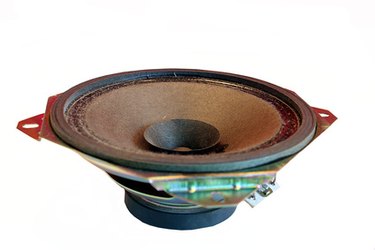
Car speakers typically are installed in vehicle doors or wall paneling. To make a car speaker portable, you first should design an encasement to protect the speakers from damage. The ideal enclosure will insulate sound produced by the speaker and thus ensure optimum performance.
Things You'll Need
- Compressed sawdust
- Wood screws
- Drill gun
- 5/16-inch drill bit
- Speaker wire
- Router saw
- Table saw
- Pencil
- Measuring tape
Instructions
-
Building the Enclosure
-
1
Place the large face of the speaker flat on the plywood you are using. Trace the edge of the speaker on the wood. Allow 2.5 to 3 inches of room in every direction on the wood between your tracing and the edge of the wood.
-
2
Cut the piece of wood to the size that you want your speaker to be Cut the piece of wood onto which you traced the speaker to the desired size of your enclosure, using a table saw. The size of the enclosure may vary depending on the size of your speaker, but make sure to leave room at the four edges of the wood. This is where the face of the speaker will sit. Once you determine the size of the piece, cut three additional pieces to the exact size as well.
-
-
3
Find the tracing you have drawn. Cut along the tracing using your router saw. Be careful when making this cut--a slip of the hand could ruin the entire piece of wood.
-
4
Drill a small hole in one of the three remaining boards using your 5/16-inch drill bit. The hole can be anywhere on the board, but should be as close to the bottom as possible for ease of construction.
-
5
Line up one of the four boards to be perpendicular and flush with another board, so that you can form a right angle with a second board. Make sure the two boards are as flush as possible: the end product of this step should be a four-sided box. Drill one screw in each corner of the board and repeat with the remaining two boards. After finishing this step, you should have a four-sided box with an open top and bottom side.
Installing the Speakers
-
6
Car speakers are designed with tabs for car installation that work well in enclosures as well Place the speaker in the hole you cut in the wood, face up. (The large face of the speaker should face outward). The speaker should have four tabs that catch the wood, allowing the speaker to hang freely from the hole (these tabs are designed to hold the speaker in place on a car's wall paneling). Drill a screw in each of these four tabs, securing the speaker firmly in place.
-
7
Run a length of speaker wire through the hole which you drilled in step 4 of section 1. Connect it to the tabs behind the speaker. Make sure to connect the striped side of the speaker wire to the small tab, or the negative (-) port. Connect the un-striped side of the speaker wire to the large tab, or the positive (+) port.
-
8
All four sides of the top of the box should be the same length Measure all four sides of the top, open face of the boxed enclosure, using your measuring tape. Trace these dimensions on a second piece and third piece of wood. Since all four sides of the box that you cut made previously were of equal size, the four sides of the top of the box should be equal length.
-
9
Cut two pieces of wood along the tracings you just made (the two pieces should be the same size) using your table saw. Although it is not necessary for this cut to be absolutely perfect, it is best to err on the side of the piece being too large, rather than too small, because you can always go back and sand down the wood so that it fits flush.
-
10
Be careful to keep all loose clothing away from the table saw when you make cuts Set one piece of wood on one of the box's open faces and drill a screw in the center of each side of the piece of wood (four screws total). It is best to drill these screws in the center rather than the corners of the wood, so that the new screws do not hit the other screws you drilled in step 5 of section 1. Repeat this step with the other open face of the box as well.
-
11
Use the wires you connected to the speaker, and which ran through the hole drilled in the enclosure wall, to hook the speaker to your stereo receiver. Remember that the striped wire is connected to the negative port and the un-striped wire is connected to the positive port, and should be connected likewise on your stereo receiver.
-
1
Tips & Warnings
Take caution when you use both the router saw and the table saw. A slip of the hand could damage the wood and cause serious injury.
References
Resources
- Photo Credit speaker image by CraterValley Photo from Fotolia.com speaker 001 image by TheThirdMan from Fotolia.com small speaker image by timur1970 from Fotolia.com measuring tape image by Horticulture from Fotolia.com saw image by Kaarel from Fotolia.com