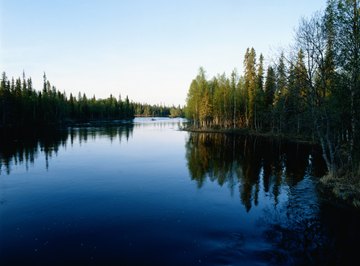

Most of the world's water is saltwater contained mostly in the oceans that cover the earth. Only about 2.5 percent of the total global water is fresh water. Fresh water is found in glaciers and ice caps and about 30 percent is groundwater, which includes lakes and rivers. Groundwater occurs almost everywhere land is -- from swamps to rocky terrains. When groundwater fills all the pores in soil or rock, the soil is said to be "saturated." The water table is the boundary between saturated and unsaturated ground and is influenced by rain, snow, irrigation, droughts and active wells in the area. Most fresh water for human use comes from groundwater.
Water Table Characteristics
Soil moisture beneath the land surface occurs in two zones: the unsaturated zone and the saturated zone. The spaces, or pores, between grains of sand, soil or rocks are only partially or not at all filled with water in the unsaturated zone, while the spaces are completely filled with water in the saturated zone. The water table delineates the boundary between these two layers. A thin layer just above the water table is called the "capillary fringe." The capillary fringe is from a few centimeters (about 1 inch) to 60 centimeters (about 2 feet) thick, and is created by water being pulled up from the saturated zone by capillary action. The depth of the water table varies depending on the composition of the land, from zero in swampy areas to more than 25 meters (300 feet) deep. Some water tables intersect with lakes and rivers and are modified by them. Water tables are not flat or horizontal: they often follow the conformation of the land and are usually slightly inclined, causing groundwater to flow.
Groundwater Flows
Precipitation, such as rain, enters streams and lakes and percolates into the ground. Drawn downward by gravity, the water starts to fill the empty or partially empty spaces in the soil or between rock particles. When the infiltrating water reaches the water table and the saturated zone, it starts to move horizontally with the groundwater. Groundwater in the saturated zone flows from higher to lower elevations. Unlike the water flow in streams and rivers, groundwater moves very slowly. Movement in sandy or gravelly soil may be millimeters per day, and in clay the movement may be even slower.
Factors Affecting Groundwater Velocity
The major factors affecting the velocity of groundwater flows are porosity, the number of available open spaces in soil or rock; permeability, the interconnectivity of the pores; and hydraulic gradient, the slope of the water table. Groundwater velocity increases with increasing permeability and hydraulic gradient. Sand, gravel, sandstone and some types of crystalline rock allow groundwater to flow easily, while fine-grained sediments, such as shale and silt, prevent easy movement of groundwater.
Groundwater Aquifers
Aquifers are underground reservoirs that hold abundant groundwater in pores or spaces. Most of the world's fresh drinking water is withdrawn from aquifers. Some aquifers are created by layers made up of clay-rich soil or bedrock. Melting snow or rain creates a saturated zone above the confining layer, because water is prevented from seeping down beyond the confining layer. The flow of aquifers depends on both gravity and the pressure created by the elevation of the land. Confined aquifers hold groundwater under pressure, while unconfined aquifers are not pressurized and the water level will not rise above the water table when punctured.
References
About the Author
Based in Connecticut, Marie-Luise Blue writes a local gardening column and has been published in "Organic Gardening" and "Back Home." Blue has a Ph.D. in biological sciences from the State University of New York at Stony Brook and wrote scientific articles for almost 20 years before starting to write gardening articles in 2004.
Photo Credits
David De Lossy/Photodisc/Getty Images