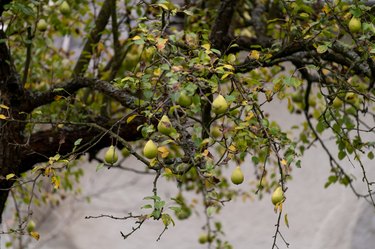
Both European pear trees (Pyrus communis) and Asian pear trees (Pyrus pyrifolia) are important fruit tree species in the United States, and like many other fruit trees, they are produced by grafting the desired variety of pear onto a rootstock. The trees have an upright growth habit, and those grafted onto seedling rootstocks can be tall. All pear varieties set better crops with cross-pollination, although some cultivars and varieties, such as Seckel, can set adequate crops when planted alone.
Pear trees need to be pruned immediately at planting time, and they require annual pruning to keep them healthy, productive, and looking their best. It's important to get an idea of how to prune a pear tree before you begin.
Video of the Day
The Best Time to Prune a Pear Tree
The best time to prune a pear tree depends on the type of training or pruning you are doing. When you want to prune a pear tree to remove suckers and water sprouts or to maintain a balance between vegetative growth and branches, summer pruning is best. To remove large branches and/or replace the leader in the center of the tree, winter pruning during the dormant season is preferred.
How to Prune a Pear Tree at Planting
Apple trees and pear trees require similar care, but pear trees are generally easy to maintain. They require less complex training and pruning and also have fewer insect issues.
It's best to prune pear trees when they are first planted in your home orchard. Pruning fruit trees in this way is often called training and should be accomplished in early spring. The purpose of training is to set the branch structure of the tree, leaving primary branches (termed "scaffold branches") and reducing lateral branches. Because pears have a tendency to grow very narrow crotch angles, training is necessary to develop a strong branching structure.
Whether you're pruning apple or pear trees, the process depends on the current size and shape of the tree. When planting larger, older trees, remove all branches coming from the base of the tree plus all branches lower than 24 inches. Select a strong upward branch for the central leader and then prune out other branches that compete with the leader. Use pruning cuts called "thinning" that remove the entire shoot or limb to its point of origin on the main trunk or branch. A pruning saw can work well for this. Select between three and five well-placed side branches with wide angles (at least 60 degrees) as scaffold branches to form the main branches of the tree.
Some experts suggest that unbranched whips on calleryana rootstocks are the best young pear trees to plant. If you have planted a whip (a slim, unbranched shoot) or a smaller tree without strong branches, prune back the whip or shoot to 24 to 30 inches above the ground. Make the cut on a 45-degree angle just above a bud. This will cause the tree to branch and produce side shoots that will be scaffold branch options for the next year. The second growing season, prune off any limbs that are less than 18 inches and select the scaffold branches.
Annual Pruning of Pear Trees
Most fruit trees grow best with an annual pruning to balance vegetative growth and fruit production, and pear trees are no exception. But because of the pear's vulnerability to fire blight, directions for how to prune a pear tree are usually limited to pruning out water sprouts and root suckers and thinning out crossing branches to allow better light penetration and air circulation. This is best done as summer pruning.
To maintain the ideal height of a mature standard pear tree (between 15 and 18 feet), cut back the central leader to a weaker, vertically growing side branch in the center of the tree every few years. Do this as part of winter pruning in late winter or early spring. This is also the best time to remove any overly large branches from the pear tree.
Thinning Pear Fruit
Both pear trees and apple trees are likely to set more fruit than they can carry to maturity. Remove all fruit except for one per cluster, and thin clusters so that there's one cluster every 6 inches along each limb. Failure to do this will decrease flower buds for the following year and cause the tree to bear fruit only every other year.
Pruning Ornamental Pear Trees
An ornamental pear tree is one grown for its lovely spring flowers rather than edible pears. Any fruit an ornamental pear tree produces may be eaten by wildlife but is not generally consumed by humans. Prune these trees in late autumn to maintain a harmonious canopy, to remove dead or damaged wood, and to encourage airflow in the center of the trees. Pruning back an ornamental tree annually will remove flower buds and limit the display of blossoms.