
How to Inflate Bike Tires Without a Pump
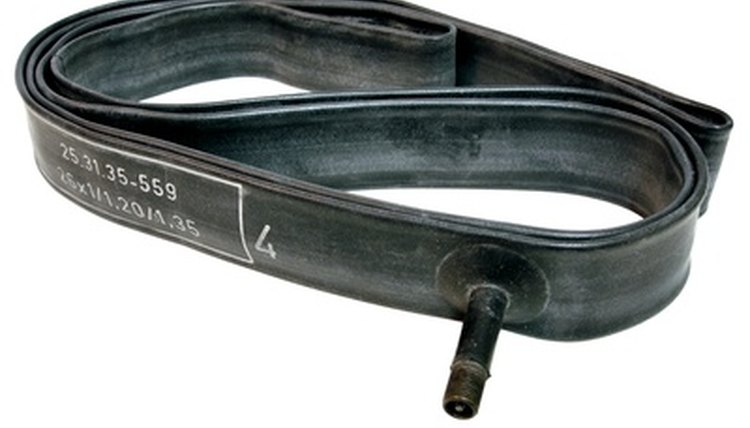
Cyclists who abide by the unwritten rules of cycling always have a pump with them, either attached to the frame or stowed in a pannier. However, if you don't have a small portable pump you can still inflate low pressure tires with a CO2 cartridge. These small cylinders take up little room in your seat bag and most have enough air in them to fill both your tires. Learning to use a CO2 cartridge takes only a few moments. If you don't have a cartridge or a pump, you can get some air into a tire by blowing it up like a balloon with your mouth.
Using A CO2 Cartridge
Attach the CO2 cartridge to the nozzle. If you have a cartridge with a threaded neck, screw the neck of cartridge into the nozzle. If you have a cartridge with a smooth neck, insert the neck of the cartridge into the nozzle.
Check your tire. If it is completely flat, fit the nozzle snugly onto the valve stem, open the nozzle and let the air flow for only a second or two. Close the nozzle and inspect the wheel to see that the tire is seated properly. If the tire is not completely on the rim, adjust it with your hands.
Open the nozzle and fill the tire. Different size cartridges will put different amounts of air in your tires. For example, a 25-gram cartridge will be enough to fill both tires on your mountain bike, but not enough to fill both tires on a road bike. Learn what size cartridge you need for your tires when you buy the cartridges.
Close the nozzle and pull the nozzle off the valve. Pull up as straight as possible to avoid damaging your tube.
Manually Blowing Up A Tire
Wipe the valve of your tire off with your shirt or other piece of cloth.
Blow a small amount of air into your tire. Use your tongue to press on the valve to keep it open as you blow. Inspect the wheel to see that the tire is seated properly. If the tire is not completely on the rim, adjust it with your hands.
Continue to inflate the tire by mouth. This takes time and is awkward, but it's better than being stranded.
Tips
There are different types of nozzles to choose from. Some have a stop mechanism to shut off the air flow when the tire is full, others don't. The ones that don't will use up an entire CO2 cartridge once the cartridge is open. When buying a nozzle you also need to get the right head for your tire's valve. A valve that looks like a car tire valve is called a Schraeder valve. A long skinny valve is a Presta valve. If you have a nozzle that doesn't have a stop mechanism, wait to attach the cartridge after you have fitted the nozzle onto the valve.
References
Writer Bio
Based in Portland, Ore., Tammie Painter has been writing garden, fitness, science and travel articles since 2008. Her articles have appeared in magazines such as "Herb Companion" and "Northwest Travel" and she is the author of six books. Painter earned her Bachelor of Science in biology from Portland State University.