Hiking through open woodland and forests, ravines, slopes and bluffs you might see wild chokecherries. Native shrubs or small trees of Newfoundland, Saskatchewan, North Carolina, Tennessee, Missouri and Kansas, chokecherries (Prunus virginiana) are hardy in U.S. Department of Agriculture plant hardiness zones 2 through 7 and have naturalized in many areas of the United States. Chokecherry fruits are too astringent to eat raw (hence their name), but make delicious jellies, jams, sauces and pies. Native Americans used them as an ingredient in "pemmican," a meat-based winter staple, and brewed chokecherry bark to make tea. Identification of chokecherries depends on the season.
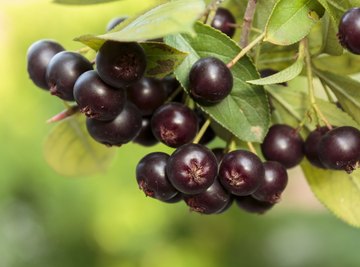
Western chokecherry (Prunus virginiana demissa) bears dark red fruit, Prunus virginiana melanocarpa bears black fruit and Prunus virginiana virginiana produces crimson to deep red and occasionally white fruit.
Chokecherries are easily confused with buckthorns (Rhamnus cathartica), which grow in USDA zones 3 through 8. Buckthorns look similar to chokecherries but their leaves grow in opposite pairs along the stems and their fruits appear singly, not in clusters. Buckthorn fruits are poisonous both raw and cooked.
Raw chokecherry fruits are poisonous.
Observe the location form and size of the shrubs or small trees. Chokecherries usually grow in open, sunny or partially shaded areas in thickets, which are groups of thin trunks, or as single trees. Chokecherries rarely grow taller than 9.1 meters (30 feet), and their crowns are 3 to 6 meters (10 to 20 feet) wide and irregularly shaped.
Check the color of the shrubs or trees' bark. Chokecherries' bark is gray or reddish-brown when the trees are young and turns brownish-black as they age. Chokecherry bark is also marked with horizontal rows of raised pores, which develop into shallow grooves on mature trees.
Examine the leaves. Chokecherry leaves are a dark, glossy green above and pale on their underside. They are 2.5 to 10 cm (1 to 4 inches) long and 1.9 to 5 cm (3/4 to 2 inches) wide. The leaf edges are serrated, and leaves grow alternately on opposite sides of the stems, not in opposing pairs. Chokecherry leaves turn yellow in fall and the trees are bare over winter.
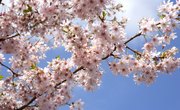
Observe the shrubs' blossoms, which appear in April through July. Chokecherry blossoms appear before the leaves are fully open, and grow in flowering spikes 7.6 to 15.2 cm (3 to 6 inches) long. Individual flowers are 0.6 to 1 cm (1/4 to 3/8 inch) wide and contain five white petals. The flowers are fragrant.
Examine the fruits on shrubs in late summer and early fall. Chokecherry fruits grow in clusters and are spherical, measuring 0.6 to 1 cm (1/4 to 3/8 inch) in diameter. Their color varies from white through deep red to black, according to the variety. Chokecherries usually drop their fruits by mid-fall.
Crush the fruits underfoot on hard ground. Chokecherry fruits are filled with pulp and many seeds. Half a kilo (1 pound) of fruit contains 3,000 to 5,000 seeds.
Tips
Warnings
References
Tips
- Western chokecherry (Prunus virginiana demissa) bears dark red fruit, Prunus virginiana melanocarpa bears black fruit and Prunus virginiana virginiana produces crimson to deep red and occasionally white fruit.
- Chokecherries are easily confused with buckthorns (Rhamnus cathartica), which grow in USDA zones 3 through 8. Buckthorns look similar to chokecherries but their leaves grow in opposite pairs along the stems and their fruits appear singly, not in clusters. Buckthorn fruits are poisonous both raw and cooked.
Warnings
- Raw chokecherry fruits are poisonous.
About the Author
A graduate of Leeds University, Jenny Green completed Master of Arts in English literature in 1998 and has been writing about science since 2007. Green's work appears in Synonym, Sciencing, and other websites and ezines