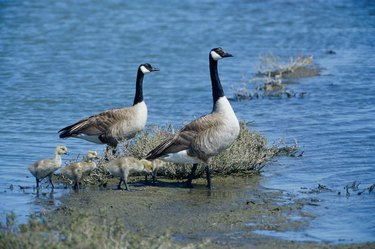
Canadian geese are beautiful and interesting birds, whether you're interested in observing them in the wild or raising them yourself. If you're looking to raise and train geese or even use a goose for home security, learning how to tell the males and females apart is a useful skill.
It may be difficult to tell just by looking at Canadian geese, but through observing their behaviors and social interactions may yield helpful clues. Males and females have subtle differences in morphology and plumage, but the greatest divergence lies unsurprisingly in the details of the reproductive organs and the genes. Investigating either of these characteristics requires the help of your veterinarian or a diagnostic laboratory.
Video of the Day
Video of the Day
Behavioral and Social Differences
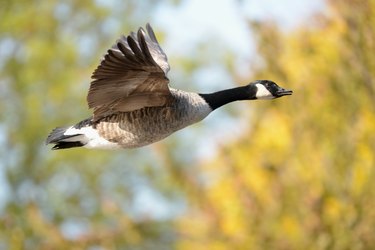
According to the Audobon Field Guide, females perform most of the nest construction and handle all of the egg-incubation duties, so those observed sitting on nests are female in all likelihood. Additionally, while females will defend their eggs, nests and young, males provide most of the protective duties and are often the first to respond to interlopers. Canadian geese select mates that are similar to their own size; still, the males, or drakes, are generally the larger member of the pair. Clashing geese are often males who are battling for territory.
Observable Physical Differences
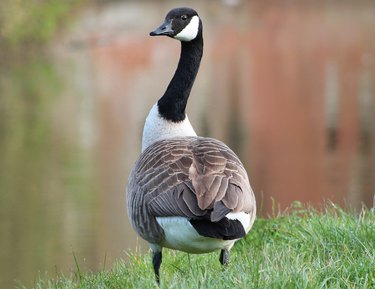
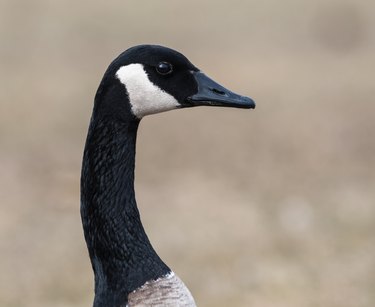
Female Canadian geese have pointed tails, while males possess rounded tails, according to the Beauty of Birds. Sub-adults have rounded tails too, but a notch is usually present that can distinguish them from mature males. The bills of males bear a slightly different shape from those of the females, being more rounded — even bulbous — in appearance. Females have slightly pointed bills. The neck of both sexes differs as well, being shorter and slimmer in females and longer and thicker in males. Additionally, males have larger, wider head crowns than females do.
Cloacal Examination
The best way to determine the sex of any bird is to have a veterinary expert evaluate cloacal opening of a bird. By inserting a lubricated finger into the bird's vent, the vet can attempt to palpate a penis, which, if present, indicates that the bird is a male. This is an unusual technique for determining bird gender, as only about 3 percent of the living bird species possess penises. Alternatively, the vet can cause the penis to evert by applying pressure to the proper portion of the vent. This is a potentially dangerous technique, which should only be performed by a veterinarian.
Genetic Testing
The Department of Primary Industries in the UK recommend most reliable method for determining the gender of a goose is via genetic testing. To do so, a sample of DNA — usually in the form of a feather — is examined to determine if it has male or female chromosomes. Your veterinarian may be able to perform such tests for you, or you can seek out a commercial lab that offers genetic sex testing.
- Cornell Lab of Ornithology: Canada Goose
- Audobon Field Guide: Canadian Geese
- Coalition to Prevent the Destruction of Canada Geese: Frequently Asked Questions
- Science Blogs: Ballistic Penises and Corkscrew Vaginas – The Sexual Battles of Ducks
- Beauty Of Birds: Canada Geese
- GPNC: Canada Geese
- Pet Informed: Sexing Birds
- Department of Primrary Industries: Animals and Livestock