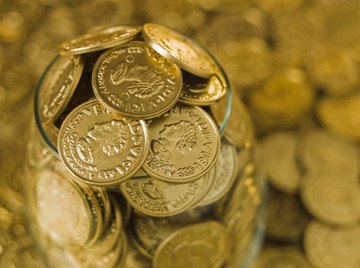
It may look like gold, but appearances can be deceiving. Fortunately, simple analysis performed in your kitchen can begin to reveal the truth. Elements have natural signatures that allow you to identify them and measure their purity. One such signature is the density of the element. The density, which indicates how closely the atoms are packed, is the ratio of a specimen's mass to the volume it occupies. Gold has a density of 19.3 g/cc. By determining the specimen's density, you will take a significant step towards revealing whether it is indeed gold.
- Scale
- Graduated cylinder
- Water
- Calculator
Note that metals may be combined to form alloys. It is possible to combine a minimum of three metals to yield a density that mimics that of pure gold. If a specimen has a measured density matching that of pure gold, it is recommended that further analysis be conducted to confirm that it is indeed made of pure gold.
Measure the mass of the gold object on the scale. Record the mass in grams (g).
Pour water into a graduated cylinder until the cylinder is approximately half full. Record the water level in cubic centimeters (cc), being careful to read the bottom of the meniscus (the curved shape of the surface of the water). Let this water level measurement be referred to as the initial volume, or "Vi." Note that 1 milliliter (ml), which is a common volume unit used on the graduated cylinder, is equivalent to 1 cc.
Carefully lower the gold object into the cylinder. Ensure that no water is splashed from the cylinder as this will result in an inaccurate reading.
Record the water level in the cylinder with the gold object submerged. Let this volume reading (measured in cc) be referred to as the final volume, or "Vf."
Calculate the difference in water levels before and after submerging the object. For example, the difference = Vf - Vi.
Divide the mass of the object by its volume to yield the density of the object. For example, the object density = mass / (Vf – Vi). Compare the measured density to that of pure gold (19.3 g/cc) to determine whether the object is made of pure gold.
Things You'll Need
Warnings
References
About the Author
Pearl Lewis has authored scientific papers for journals such as "Physica Status Solidi," "Materials Science and Engineering" and "Thin Solid Films" since 1994. She also writes an education blog entitled Simple Science in Everyday Life. She holds a doctorate from University of Port Elizabeth.
Photo Credits
Jupiterimages/Comstock/Getty Images