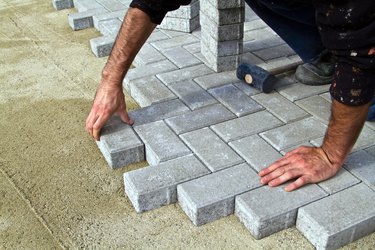
Building a stone brick patio that will last the life of your home doesn't have to be a difficult process. Using a sand foundation rather than a concrete slab greatly reduces the complexity of the job, saving you time and effort without sacrificing quality. With the proper tools and equipment, you can build a stable, durable brick patio in one weekend.
Buy bricks that are intended for paving surfaces. Some are made from traditional fired clay, while others are cast concrete products. Clay paver bricks, although they can be very attractive, are softer and may not hold up as well without annual sealing.
Video of the Day
Video of the Day
Step 1
Decide on the overall look of your patio. There are a wide variety of brick colors and sizes available. Draw your planned design and pattern on a piece of paper to scale for ease of planning and laying the patio. If you have the space, size your patio so as to contain as many whole bricks as possible to reduce the number of bricks you must cut. Square or rectangular shapes make this easier—curved edges almost always require some cutting of bricks.
Step 2
Place lawn flags around the proposed perimeter of your patio to mark the borders for excavation. After making your desired location, call your local utility companies and ask them to check the area for underground pipes and lines before you dig.
Step 3
Purchase enough bricks to do the job based on your design plus an additional 10 percent. This extra will allow for breakage and leave a few bricks leftover for future replacement of damaged or cracked bricks.
Step 4
Excavate the base for the foundation of your patio to a depth of seven to eight inches using a shovel. You need to allow for four inches of gravel, an inch of sand and the thickness of your bricks themselves. Smooth out the excavated area as much as possible using a garden rake. Compress the floor of the hole with a plate compactor so that your foundation is as firm as possible. You can rent a plate compactor from a home improvement store or equipment rental shop.
Step 5
Pour a four-inch layer of compactable gravel into the excavation to serve as a drainage base for the patio. Go over the gravel with the compactor to compress and level it. As you level the gravel, create a gentle slope away from your home's foundation to encourage proper drainage. Your patio should slope 1/8 to 1/4 of an inch per foot.
Step 6
Pour a layer of sand into the hole, one inch deep, covering the gravel. Level the sand with a screed board, following the slope established with the gravel earlier. Drag the long wooden screed along the surface of the sand to flatten it out, working the board in a back-and-forth motion as you go.
Step 7
Lay the bricks for the patio onto the sand foundation, placing them level on the sand's surface and tapping them into place with a rubber mallet. Place the bricks so that they butt tightly together, beginning in one corner of the patio or against the edge of a structure and working your way towards the outside edge of the patio. Periodically check to make sure the surface is flat, using a long 2 x 4 as a straightedge. Cut bricks when necessary for fit using a circular saw with a masonry or diamond blade attached.
Step 8
Place a paver edge restraint surrounding the edges of the patio to create a line between the patio and the lawn. Push the edge restraint tightly against the patio edge and then anchor the edge in place using 10-inch steel spikes driven through the edger into the ground.
Step 9
Spread polymeric sand over the patio and sweep it into the joints between the bricks with a stiff push broom. Polymeric sand has a binder added that hardens the sand to create a more durable surface.
Step 10
Place a urethane pad over the patio surface, covering the bricks, and then compact them with the plate compactor. The pad protects the bricks from damage during compacting. This step is critical, as compacting the bricks will securely settle them into the sand beneath them and pack polymeric sand more tightly into the brick joints. You can rent a pad at the same place you rented the compactor.
Step 11
Sweep the bricks again to make certain you've filled the joints with sand and to remove the sand from the surface of the bricks. Spray the patio with water to clean off any remaining sand and to activate the hardener in the sand. Read the instructions on your polymeric sand before watering the patio to avoid adding too much or too little water.