Homemade Gauss Meter

If you need to measure the intensity of a magnetic field, for safety or educational purposes, you will need a gauss meter. They are expensive and delicate, so you may not be interested in buying one but may still require its use. You can make your own homemade gauss meter, for less than a commercial one and with very little effort. You will create a circuit using a battery, a voltage regulator and a Hall device. You will need a working knowledge of circuits, however, but once you understand how they work, you can build a meter quickly and inexpensively.

Things You'll Need

  • 9-volt battery clip
  • Breadboard
  • +5 voltage regulator
  • Calibrated Hall device
  • Voltmeter
  • 9-volt battery
  • Rubber band
Show More

Instructions

    • 1

      Run the red positive wire of a battery clip through the breadboard and connect it to the input of a +5 voltage regulator. The input is pin 1 on the regulator.

    • 2

      Insert the black negative wire of the clip through the breadboard and connect it to the second pin or the common of the regulator.

    • 3

      Connect the first pin of the Hall device, the +5 input, to the output of the regulator, the third pin. These wires should all be led through the breadboard to hold them in place.

    • 4

      Attach the common or second pin of the Hall to the common of the regulator. The common of the battery clip, regulator and Hall device should all be together now.

    • 5

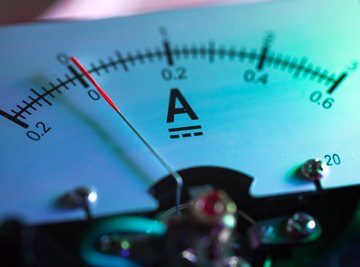
      Set the voltmeter so its display reads 20Vdc max. The voltmeter will not be attached to the breadboard but should be place near it so it can be wired up to the power.

    • 6

      Connect the positive wire of the voltmeter to the Hall device output, or pin 3.

    • 7

      Attach the negative of the voltmeter to the joined common wires.

    • 8

      Snap a 9-volt battery onto the battery clip connected to the other wires.

    • 9

      Secure the battery in place by putting a rubber band around it and the breadboard and twisting it around until the battery is held firmly in place.

    • 10

      Use the calibration chart included with your Hall device to set and use your gauss meter.

Tips & Warnings

  • A voltmeter is a useful tool to have when building many different electrical meters.

  • Use only a calibrated Hall device or your measurements cannot be assumed to be accurate.

Related Searches:

References

Comments

You May Also Like

  • How to Measure the Strength of Magnets With a Gaussmeter

    Electronic orbitals of atoms can contain a maximum of two electrons. Some compounds contain atoms with "unpaired" electrons, or electron orbitals that...

  • How to Build a Magnetometer

    A magnetometer is a device for measuring magnetic fields. The earth generates a magnetic field that permeates the entire planet, but many...

  • What is a Gauss Meter?

    Gauss meters measure the strength of magnetic fields. While some only measure the magnitude of the field, others also measure the direction....

  • How to Use a Gauss Meter

    A Gauss meter, also known as a magnetometer, is an electronic instrument for measuring the strength of magnetic fields, usually in units...

  • How to Build a Gauss Meter

    A gaussmeter measures the strength and direction of a magnetic field and may also be called a magnetometer. The standard unit of...

  • Homemade Field Strength Meter

    An RF field strength meter is possibly the easiest piece of test equipment one can build. It can be used as a...

  • How to Use a Multimeter as a Gauss Meter

    A gauss meter is a device for measuring small magnetic fields. A multimeter is a combination of tools for measuring voltage, current,...

  • How to Find the Gauss of a Magnet

    The strength of the magnetic field produced by a permanent magnet, or any magnet not powered by electricity, is called its gauss...

  • How to Make a 10 Meter Dipole Antenna

    The building of antennas by ham radio operators has long been one of the most favorite parts of this hobby. Whether you're...

  • Homemade EMF Detectors

    When you want to know if a magnetic field is present, or if no magnetic field is in the area, you need...

  • How to Build a PH Meter

    A pH meter is a tool that measures the activity of hydrogen ions with in an aqueous solution. Measuring a solution with...

  • What Is the Gauss Rating for a Strong Magnet?

    The gauss is a measure of the strength of magnetic fields, relating force, length and electric current. It is used to conveniently...

  • How to Use Gauss-Jordan

    Gauss-Jordan elimination is a version of Gaussian elimination in solving systems of linear equations. The variable coefficients, instead of merely being reduced...

  • Homemade Light Meter

    Hand-held light meters have been standard tools of professional photographers since they were invented. They can give more accurate lighting information than...

  • How to Convert Gauss to Tesla

    Scientists use both gauss and tesla as units for the strength of a magnetic field, sometimes also called magnetic flux density. Tesla...

  • How to Build a Humidity & Temperature Meter

    A device called a psychrometer measures the air's relative humidity. It can also be used to measure the temperature. Psychrometers are easy...

  • How to Make Your Own EMF Wave Neutralizer

    We live in an electronic world, from the wiring in our walls to the power lines on our streets. Computers, appliances, and...

  • How a Milligauss Meter Works

    Milligaus meters are used to detect and measure AC or extremely low frequency (ELF) magnetic or electrical fields. One milligaus is a...

  • How to Use a Field Strength Meter

    A field strength meter is a device that can be used for many purposes. It can detect a variety of low-power transmitters,...

Related Ads

Featured