The state of Quintana Roo is located on the northeastern side of southern Mexico’s Yucatan peninsula. While mostly dominated by tropical jungle, Quintana Roo nonetheless has a wide range of biomes, from dense lowland forests and coastal plains to beaches and coral reefs. Labyrinths of limestone caves and other karst formations also punctuate the state, creating an environment where many species of animals can thrive. Among these animals are over 70 distinctive species of snakes in Quintana Roo.
Common Harmless Snakes in Quintana Roo
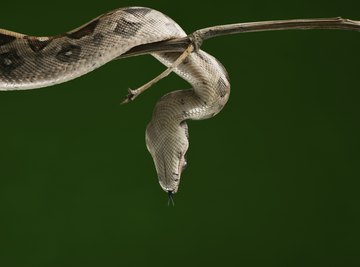
The majority of snakes in Quintana Roo lack venom, and are considered harmless. Often, harmless snakes in Quintana Roo can be identified by the lack of certain traits that define venomous species. Most common harmless species—such as the yellowbelly snake and the peninsular stripeless snake--have rounded heads and dull, brownish coloration instead of the triangular heads and bright reds and yellow colorations of the pit vipers and coral snakes, respectively. The harmless boa constrictor, for example, has a base color that can range from yellowish brown to nearly gray and saddle markings of either brown or black, with a tapered but rounded snout.
Harmless Mimics in Quintana Roo
Not all harmless snakes in Quintana Roo look like they are harmless. Some require more careful observation. Commonly encountered parrot snakes and vine snakes, for example, have very angular heads which can resemble the triangular heads of pit vipers. Another snake commonly mistaken as venomous is the variegated false coral snake which, as the name implies, mimics the banded coloration of coral snakes in the region. However, the color pattern is slightly different, as evidenced by the useful saying “red on black, venom lack; red on yellow, kill a fellow.”
Venomous Coral Snakes in Quintana Roo
The four venomous coral snake species in Quintana Roo are among the easiest to identify thanks to their bold and consistent color patterns. Coral snakes are small, slender snakes with colorful bands of black, red or orange, and yellow continuing all the way down their bodies. In the case of the Central American coral snake, the yellow may be nearly absent in some individuals. Coral snakes also have small rounded snouts and smooth scales. Despite their small size and pleasant coloration, coral snakes are extremely deadly and should never be handled.
Venomous Pit Vipers in Quintana Roo
Pit vipers make up the other group of venomous snakes in Qunitana Roo. There are several species within the state, including the notorious and deadly fer-de-lance. Despite looking fairly distinctive from one another at first glance, pit vipers all have a number of notable traits in common: a triangular head, rough (or keeled) scales and large “pits” on the snouts above the mouth. A single rattlesnake, the Yucatan neotropical rattlesnake, is present in Quintana Roo and can be identified by the traits above as well as by a tail that culminates in a rattle and the brown, blotchy patterning of its scales.
Considerations and Warnings
Because Quintana Roo is home to a number of lethal venomous snakes, always use extreme caution around snakes that you cannot immediately identify as harmless. Give snakes a wide berth, and never attempt to handle even harmless snakes. According to the Merck Manual, most snakebites occur when snakes are deliberately harassed or handled.
References
- Amphibians and Reptiles of Northern Guatemala, the Yucatan, and Belize; Johnathan A. Campbell
- Snakes of the World: A Catalogue of Living and Extinct Species; Van Wallach, Kenneth L. Williams, Jeff Boundy
- Explorando Mexico: Quintana Roo Geography
- Yucatan Wildlife: Reptiles of the Yucatan Peninsula
Photo Credits
jbmake/iStock/Getty Images