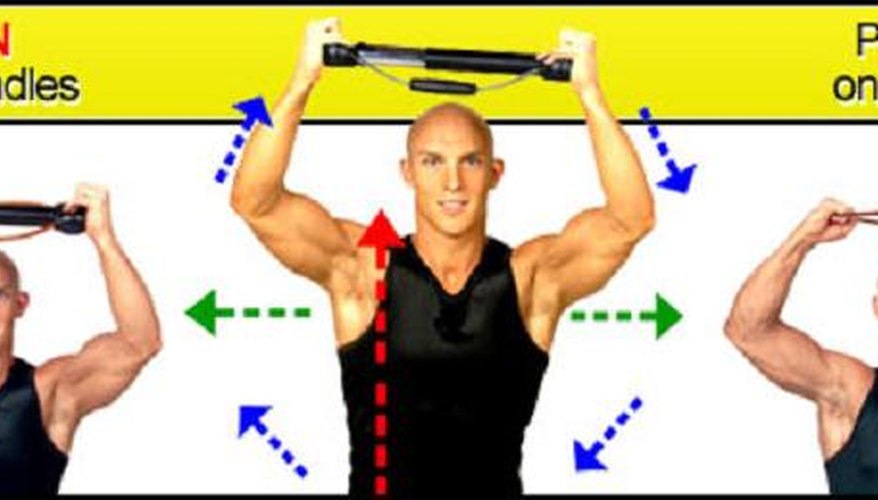
The Bullworker is a piece of isometric equipment that people can use to exercise their entire body. It is compact enough to conveniently take on trips and holidays. A Bullworker workout routine uses the principals of compression and expansion.
A small meter gauge can track a person's strength over time. Each movement is normally held for 7-10 seconds.
Chest, Shoulder and Back Exercises
For each exercise, track the progress of your meter gauge results. Do each exercise three times and hold every motion for 10 seconds
Chest Compression: hold the Bullworker in front of you with both arms bent at 90 degrees. Your arms should be nearly perpendicular to the floor. Take a deep breath, then exhale as you squeeze the handles inward.
Breathe during the exercise. Focus on squeezing the pectoral muscles of the chest. Slowly release the unit and relax.
Chest cable twist: grab the cables about eight inches apart.
Slowly twist the cables inward with both hands, focusing on squeezing your pecs. This exercise hits the inner pecs more directly.
Shoulder Compression: place the Bullworker behind your neck, holding both arms up as if making a football goalpost. Slowly compress both arms inward, focusing on the tension in your shoulders.
- For each exercise, track the progress of your meter gauge results.
- Focus on squeezing the pectoral muscles of the chest.
- Slowly compress both arms inward, focusing on the tension in your shoulders.
Lat Compression: while standing, hold one end of the unit vertically (but extended outward) against the top of your left thigh.
Place the other leg slightly forward. Grip the far handle and bend slightly at the waist. Slowly pull the weight toward you.
Keep your arms slightly bent and squeeze the lats, the back muscles that give you that athletic V-shape. Repeat with the other hand.
Do at least one set of this exercise while seated. It isolates the lats more.
Biceps and triceps exercises
Bullworker arm exercises work the triceps (back of arm) and biceps (front of arm) muscles.
Triceps Pushdown: kneel on the floor, keeping one handle of the Bullworker on the floor but against your knees. Slowly press down on the unit with both hands (one over the other) and hold it for 10 seconds. Release your tension slowly, then repeat two more times. Do this exercise on a carpet to avoid injury from slipping.
Bicep Curl: hold the bar vertically with your right hand underneath and the left on top. Using your left arm for resistance, slowly pull up on the bottom handle as you hold the top steadily.
Apply pressure with just the right biceps for 10 sets, then repeat the exercises with your left arm. Do three total sets.
- Bullworker arm exercises work the triceps (back of arm) and biceps (front of arm) muscles.
- Apply pressure with just the right biceps for 10 sets, then repeat the exercises with your left arm.
Leg exercises
Start your leg routine out with three sets of 25 squats with the Bullworker over your head.
Outer Thigh Pulls: while seated, with the Bullworker flat against the floor, hook both of your feet through the cables.
Slowly pull each leg outward and hold for 10 seconds. Repeat three times.
Calf Press: holding one end of the cable with both hands, push the other end while flexing your calf muscle.
- Start your leg routine out with three sets of 25 squats with the Bullworker over your head.
- Calf Press: holding one end of the cable with both hands, push the other end while flexing your calf muscle.
Hold for 10 seconds then repeat with your other calf. Do three sets total.
Benefits and effects
Those who train with the Bullworker can increase muscle mass and strength within 2-4 weeks.