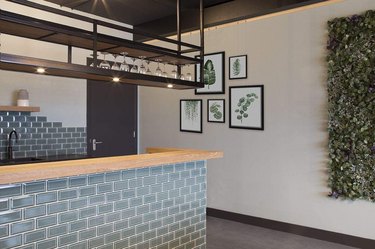
Picture rails offer the solution to the age-old issue of hanging artwork on the wall without nails and adhesives. Essentially a piece of molding with a curved gap on top for hanging things, a picture rail holds up even somewhat heavy wall art at any height you like, thanks to specialty hooks and hangers.
How Picture Rails Work
Video of the Day
A picture rail, originally made to prevent the need for nails in plaster walls, has a channel inside it to hold a hook or a gallery rod, which is a long rod with a hook on top and an adjustable hook elsewhere on its body. The top hook hangs from the picture rail anywhere along the length of the rail while the adjustable hook allows you to hang the picture at the perfect height for viewing, such as 5 feet above the floor.
Video of the Day
Some picture rail systems use nylon or steel cable attached to a picture rail hook instead of a metal gallery rod. In this case, the picture rail hook attaches to a loop on top of the cable while an adjustable hook on the cable holds the back of the artwork. As with other picture-hanging options, each element that hangs from the picture rail has a weight rating, and the lowest weight rating among them indicates the maximum allowable weight of the artwork to secure it safely along the wall. One great way to hold heavier items, which also keeps the artwork from wobbling in even a slight breeze, is to use two picture-rail hooks, setting one on each side of the art piece on the back. This distributes the weight evenly as well.
Preparing the Frame or Canvas
The picture frame needs screw eyes or D rings attached at either side about a third of the way down from the top on the back of the frame. The rings or hooks go on the side bars of the back of the artwork and should be parallel. Screw eyes are best for canvas-based pictures where the sides of the hidden canvas frame, called stretcher bars, are easily accessed on the back. Twist the screw eyes to the inner sides of these bars rather than directly on the back surface so their loops won't stick out from the wall.
Techniques for Different Looks
The materials used to connect the D rings or screw eyes to the adjustable hook hanging from the cable dangling from the picture rail allow you to customize how the finished piece looks against the wall. For vintage looks on relatively lightweight frames, run sturdy, decorative ribbon or twists of two different picture-hanging rope colors together and tie them in a loop. Loops of picture-hanging chain look similar to the rope or ribbon but with a metallic finish. When attached to the hook hanging down from the wall, the visible parts of the rope hang down at angles, creating a triangular shape with the top of the picture frame. A colorful tassel attached to the hook may be added above the frame for even more ornamentation.
For a more modern appearance, hang the pictures from metal cables dangling vertically from the picture rail hooks. If using two hooks, attach one to each ring or screw eye on the picture frame. If you prefer only one wire or gallery rod hanging down from a fairly lightweight picture, run some picture wire between the rings or screw eyes and tie it tightly behind the frame. Attach the adjustable hook on the cable or gallery rod directly to the wire and then use a level to ensure the top of the frame is perfectly horizontal.