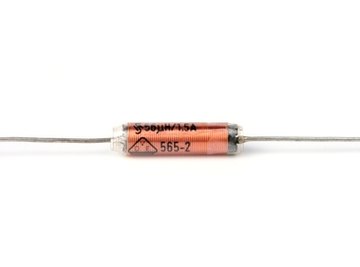

How to Calculate the Current of an Inductor

How to Calculate the Current of an Inductor thumbnail
Transformers are comprised of two magnetically-coupled inductors.

Inductors such as coils and transformers act as straight conductors when a constant direct current (DC) voltage is passing through them, but as low-pass filters with specific cut-off frequencies where they stop conducting alternating current (AC) voltages. Under the cutoff point, their current lags voltage by a time determined by voltage and inductance level expressed in Henrys (H) and more commonly millihenrys (mH). You can calculate the current of an inductor with a knowledge of the electrical parameters surrounding its circuit implementation.

Things You'll Need

  • Calculator
Show More

Instructions

  1. Single DC Voltage Pulse Current Ramp

    • 1
      Circuit boards may have very small inductors.
      Circuit boards may have very small inductors.

      Define the inductor application. An electronics lab has a wound copper wire inductor coil installed in a simple series test circuit with an variable-voltage DC power source and an adjustable time-duration switch. The pure DC resistance value of the 16.8 mH coil is 12 ohms, and a 3-volt signal is suddenly switched on. With this information you can calculate the inductor's current after 0.2 seconds and after the inductor saturates (becomes a resistive conductor).

    • 2

      Calculate the inductor's saturation current first in order to better understand its progress after 2 seconds. This reduces to a simple I (current in amps) = E(voltage)/R(resistance) calculation. Substituting known values I = 3 volts/12 ohms = 0.25 amps. This is the maximum current rate that will ever flow through this inductor coil under these conditions.

    • 3

      Calculate the inductor's current 2 seconds after the 3-volt DC signal is turned on using the formula Ipk= V*Ton/L where Ipk is the current value at 0.2 seconds, Ton is the on-time in seconds and L is the inductance in mH. Substituting stated values, Ipk = 3 volts X 0.2 seconds/16.8 mH = 0.0357 amps.

    • 4

      Calculate the time it takes for the inductor coil to reach its 0.25-amp current limit assuming a linear inductor saturation rate. Since the maximum current through the inductor is 0.25 amps as determined by its resistance and the rate of current increase is 0.0357 amps in 0.2 seconds, then total time Tt = (0.25 amps/0.0357 amps) X 0.2 seconds or 1.4 seconds.

    AC Voltage Inductor Current

    • 5

      Define the AC inductor application. In this case, the same AC inductor as above with 16.8 mH of inductance is installed in an AC circuit supplied by a plug-in wall transformer with a constant 3-volt AC output at 60 Hertz. With this information you can calculate inductor current.

    • 6
      The yellow transformer on the left can convert large currents.
      The yellow transformer on the left can convert large currents.

      Determine the inductor formula for AC operation and calculate formula values. For this case, current I = V/X where X = w (angular frequency in radians/sec) X (inductance in millihenries) L. The angular frequency w = 2 X pi X frequency (Hz). Substituting, w = 2 X 3.1416 X 60 Hz = 377 radians/second. The value of impedance X therefore = 377 radians/second X 0.0168 henries = 6.33 ohms reactive impedance.

    • 7
      This plug in power supply has a transformer with input and output inductors.
      This plug in power supply has a transformer with input and output inductors.

      Calculate AC inductor current under steady state conditions of 3 volts AC and 60 Hz. Current I = 3 volts/6.33 ohms or 0.4739 amps. However, this assumes negligible DC resistance whereas in this case, the DC resistance is 12 ohms. Therefore, the impedance and resistance must be added first R + X = 12 ohms + 6.33 ohms = 18.33 ohms. Solving for current again, 3 volts/18.33 ohms = 0.1637 amps, or about 65.48 percent of the pure DC value, which is totally reasonable for the DC to AC comparison.

Tips & Warnings

  • Calculating inductor current is only part of the total inductor implementation process. Always consider the voltage levels, other circuit components and power handling capabilities of components before finalizing a design.

  • Incorrectly designed electrical circuits can start fires, sometimes hours after they have been energized. Always disconnect experimental apparatus from the power source when it will be unattended.

Related Searches:

References

Resources

  • Photo Credit transformer image by palms from Fotolia.com printed circuit board image by Goran Bogicevic from Fotolia.com power supply image by pmphoto from Fotolia.com Power Pack image by Cinneman from Fotolia.com

Comments

You May Also Like

Related Ads

Featured