
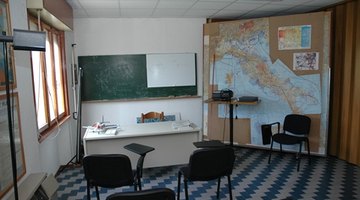


The 8th grade is a key time in the career of a young student. After all, 8th grade is the last year of junior high before high school starts. In the 8th grade, it is vital for students to make a positive impact on their academic lives in order to successfully prepare themselves for high school, college, jobs and beyond.
Step 1
Develop a strong grasp of algebra, which is a type of arithmetic. Algebra is typically the level of mathematics that is introduced to students who are at the 8th-grade level. The fundamental concepts of algebra include topics such as algebraic sums, distributive law, additive expressions, associate law, Fibonacci numbers, properties of negatives and inverses.
Step 2
Cultivate your writing and grammar skills. In order to graduate from the 8th grade, it is crucial to be well versed in the English language and grammar. Some grammatical principles that are important for passing 8th grade include use of participles and infinitives, indefinite pronouns, prepositional phrases, modifiers, subject-verb agreement, adjectives and punctuation.
Step 3
Be well-read. To successfully graduate from the 8th grade, it is beneficial to have a healthy knowledge and awareness of key classic novels. Some examples of novels include Thomas Hardy's "Tess of the D'Urbervilles," Charles Dickens' "Great Expectations," George Orwell's "1984," Mark Twain's "The Adventures of Tom Sawyer" and Louisa Alcott's "Little Women," among many others.
Step 4
Learn about the world. From the history of the world (such as the Holocaust of World War II and Napoleon Bonaparte's reign) to geography, having a deep understanding about the world as a whole is essential for 8th-grade completion. From knowing about the longest river on earth to the most populated nation and on which continent Paraguay is situated, detailed geographic knowledge is a must-have.
Related Articles







References
Writer Bio
Lars Tramilton has been writing professionally since 2007. His work has appeared in a variety of online publications, including CareerWorkstation. Tramilton received a bachelor's degree with a focus on elementary education from Kean University.