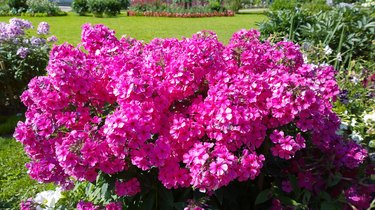
Many gardeners rely on native perennial phlox to provide reliable summer displays in perennial gardens. Garden phlox (Phlox paniculata) is among the favorites. Phlox produces spikes of brilliant blooms that rise above the foliage and light up the garden for six weeks or more. Can deadheading encourage a second flowering later in the season? Sometimes it does just that.
Meet the Native Phlox
Video of the Day
Phlox paniculata has so much going for it that it seems its common name should be "super phlox" instead of "garden phlox." It is a native perennial that grows from 1 to 4 feet tall, forming vibrant clumps that fill with bright blossoms from midsummer to mid fall. Some flowers are fragrant. You can also find shorter ground cover varieties and some cultivars that start blooming in late August.
Video of the Day
What color are phlox flowers? Almost every color you can name, including pink, orange, purple, red, and white. Cultivars extend the color range to electric shades and soft pastels. Garden phlox is a good garden citizen. It plays well with almost all other perennials, attracts hummingbirds, and is appreciated by wild birds. It has been known to escape cultivation and naturalize in areas beyond.
Care for Your Phlox
Phlox is a native plant, which means it is not very demanding. As is true with most plants that bloom prolifically, it prefers a full sun location, but if you are willing to settle for less flowers, it will tolerate some shade. The more shade, however, the more the plant is susceptible to disease.
Give your phlox moist, well-drained soils that are rich in organic nutrients, if possible. Water phlox when summers are dry but never water the foliage, as wet leaves can cause diseases. As an additional way to keep the roots cool, mulch well. Leave adequate spacing between plants to allow for air circulation which helps prevent powdery mildew. The ideal location for phlox is in an open area away from trees and shrubs that can steal nutrients and water as well as block air circulation. You may need to thin out the plants if they are becoming too crowded. And don't forget to deadhead.
Deadhead Your Phlox Flowers
The term "deadheading" is familiar to most gardeners. It means to remove faded blooms of garden plants by snipping them off. Deadheading is done for aesthetic reasons, since lots of dead flowers usually detract from a garden's appeal. But in some cases, it actually prolongs the bloom period and prevents the plant from self-seeding. This is the case with phlox.
Self-seeding may sound like a great idea, but wait! Are you growing a specimen phlox, or have you purchased a cultivar? If your phlox produces seeds, the resulting seedlings will not resemble the parent and will usually turn out to be a different color and even a different size than the parent. Deadheading the flowers as they fade prevents seeds from forming. An added benefit: Sometimes taking off the dead flowers will encourage the plant to produce an unexpected second smaller flush of blooms.
Deadheading is easy. Using a clean, sharp pruner, simply trim off spent flower clusters as they wither. Make the cut 1/4 inch above the bud that is forming immediately beneath the spent flower cluster.