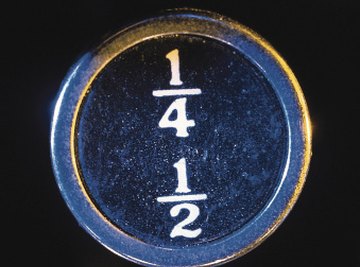

A rational number is any number that can be expressed as a fraction. A fraction is a number that is used to represent a part of something. For example, a piece of pie is a fraction of a pie. If you have 5 slices of pie, one slice is 1/5 of the pie. The number on top of a fraction is called the numerator. The number on the bottom of a fraction is called the denominator. Rational numbers never have zero as the denominator. Once you learn how to divide fractions, you can divide rational numbers.
When dividing positive and negative rational numbers, the result is always negative. When dividing two numbers of the same sign, the result is always positive.
Write an equation with the rational numbers represented as fractions. For example, 2/4 ÷ 2/3 =
Find the reciprocal of the second rational number by reversing the numerator and the denominator. For example, the reciprocal of 2/3 is 3/2.
Multiply the first fraction by the reciprocal of the second fraction. For example, 2/4 x 3/2 = 6/8
Reduce the final fraction to the lowest common denominator by dividing the numerator and denominator by the greatest common factor. For example, the greatest common factor of 6/8 is 2, so 6 ÷ 2/8 ÷ 2 = 3/4.
Tips
References
Tips
- When dividing positive and negative rational numbers, the result is always negative.
- When dividing two numbers of the same sign, the result is always positive.
About the Author
Kelli Rogers has been a professional technical writer since 1997. She has written e-learning courses for companies ,including Avon and Rockwell Collins. Rogers' travel articles appear in "Cayman Air Magazine" and "The Arizona Republic." She has a Master of Arts in English from George Mason University.
Photo Credits
Comstock Images/Comstock/Getty Images