Things You'll Need
Cat food
Water
Tweezers or small stick
If you find a lost or abandoned baby bird, you may find yourself suddenly playing Mama Bird. After warming the little one in your hands, your most urgent duty is to feed the baby. Feeding a baby bird may feel overwhelming because you don't have a mother bird's ability to swoop through the air and locate high-protein food for her babies. Relax. A baby bird can thrive on the same thing you feed your feline friends—cat food.
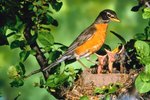
Determine if the bird is a nestling or a fledgling. A nestling has either fuzz, no feathers, or a few early feathers. It is mostly naked and not very mobile. Nestlings need more frequent feedings. A fledgling is feathered, mobile and possibly already trying to learn to fly. It will be able to self-feed shortly and may initially resist being fed by something other than its own parents. Whether the bird is a nestling or fledgling determines how long and how often to feed it cat food.
Analyze whether the baby bird gapes or not. Baby birds that gape, or open their mouths wide to be fed, have yellow or yellowish-white coloring on the sides of their beaks and have yellow inside their beaks, while those who suck regurgitated food from their parents' beaks do not have yellow marks on the side. How the bird responds determines the method you will use to feed cat food to the bird.
Soak a bit of cat kibble in hot water, preferably with a drop of corn syrup mixed in the first two days. After an hour the kibble is soft and cool enough for the baby bird to eat.
Hold a small amount of the soft moist cat food at the end of a pair of tweezers or on a stick and offer it to a gaping bird such as a swallow. If the baby bird does not open its mouth, tap very gently on the side of the beak until it opens its mouth. On rare occasion you will need to open the beak manually by prying the sides apart gently. Drop the cat food in the back of the baby bird's open mouth. Give the bird a few small pieces of moist cat food at each meal. Repeat this every 30 minutes during the day for nestlings, or every 15 minutes if the baby is very weak and in need of the protein cat food offers. As the baby grows into a fledgling it may indicate with begging and chirping that it is hungry.
Place a few pieces of the softened cat food inside a pen cap or a similar container to feed a non-gaping bird such as a dove. Gently grasp the beak and move your fingers up and down to encourage the bird to open its mouth. Place the container gently at the end of the baby bird's beak. Wiggle the cap a bit. The bird should reach in and suck the cat food. If it does not suck up the cat food mixture, simply place a bit inside the end of its beak. Repeat every 30 minutes during the day.
Deposit softened cat food in a shallow dish on the floor of the bird's container if the bird is a fledgling. To show the fledgling where the cat food is, feed it directly from the dish. It should begin to eat it on its own, although you will still need to hand feed it until it indicates its preference for self-feeding by eating from the dish while refusing your offers of food.
Prepare freshly soaked cat food each morning because the previous day's food will sour. If desired, use canned cat food in the same manner as the soaked kibble. Mixing other foods into the cat food will accustom the bird to different flavors. Baby food and apple sauce are the simplest options, although fresh vegetables and hard-boiled eggs are excellent choices as well.
Tips
It is illegal to keep most wild birds. With that in mind, handle the bird as little as possible so it does not become habituated to humans and to prepare it for release into the wild.
Contact a bird rehabilitation center as soon as possible with any questions or problems or to determine if the bird would be better off at the center.
Warnings
Be sure the cat food is not dripping with water, since a bird could aspirate the excess moisture and develop a lung infection or drown.
For the Birds Rehabilitation Foundation cautions against hand-feeding precocial birds, that is, birds that are born ready to self-feed such as quail, killdeer and poultry.
References
Photo Credits
-
Chicks In Nest image by maureen dainty from Fotolia.com
Writer Bio
Christy Bagasao has been writing since 1991. She is an English and communication graduate of Wisconsin Lutheran College with a year spent at Nottingham University in England. Her work has appeared in such publications as "Forward in Christ."