
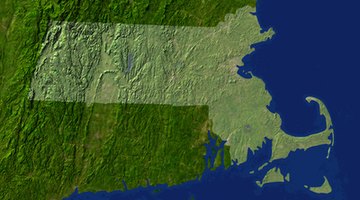


The Massachusetts Comprehensive Assessment System (MCAS) is an academic exam given to students who attend schools supported by public funds, such as public schools and charter schools, in the Commonwealth of Massachusetts. Passing the English and math sections of the exam when the test is administered in the 10th grade is a requirement to receive a high school diploma. If a student does exceptionally well on the MCAS, it will not only help them on the road to graduation, but could win them one of two college scholarships awarded by the Massachusetts Department of Elementary and Secondary Education.
The John and Abigail Adams Scholarship
As explained by the Massachusetts Department of Elementary and Secondary Education, the John and Abigail Adams Scholarship provides a tuition waiver for eight semesters at a public college or university in Massachusetts for undergraduate study. A list of community colleges, state colleges and universities that can accept this scholarship are listed on the Massachusetts Department of Elementary and Secondary Education website. In order to be considered for this scholarship, a student must attend and graduate from a public high school in Massachusetts, be a U.S. citizen or permanent resident, score Advanced and Proficient on the English and math sections of the MCAS when taken in 10th grade and "have a combined score that places them in the top 25% of the graduating class in their district."
Past Winners of the the John and Abigail Adams Scholarship
Winners of the the John and Abigail Adams Scholarship can be found throughout the Commonwealth. For example, at Brockton High School 242 students in the class of 2009 received this award. This was the maximum amount that Brockton High School could allow. In 2010, 50 students were awarded the Scholarship from the Blue Hills Regional Technical School.
The Stanley Z. Koplik Certificate of Mastery Award
Like the Adams Scholarship, this award waives tuition at any public college or university in Massachusetts for undergraduate study. This award highlights student academic achievement on both the MCAS and other examinations. To be eligible for this award, the student must be a resident of Massachusetts, a U.S. citizen or eligible non-citizen and currently enrolled in a public high school. Again, as explained by the Massachusetts Department of Elementary and Secondary Education, the student must score an advanced mark on at least one MCAS subject and proficient on all other subjects during 10th grade testing. Students must also have either two Advanced Placement (AP) exams with a score of three or better or two SAT II exams with a subject dependent minimum score. A student can also have one SAT II exam with one AP exam, one SAT II exam and one other achievement exam, or one AP exam and one other achievement exam. The exams must cover both the areas of the art/humanities and math/science. Once awarded, students must maintain a 3.3 GPA.
Past Winners of the The Stanley Z. Koplik Certificate of Mastery Award
The graduating class of 2010 at Milford High School had 19 students who received the Stanley Z. Koplik Certificate of Mastery Award. At Dover-Sherborn High School, 110 members of the class of 2011 received the Award.
Related Articles








Writer Bio
Beth Greene was first published in the "Journal Irish Historical Studies" in 2000. She holds a Bachelor of Arts from the National University of Ireland, Galway, a Master of Philosophy in medieval history from Trinity College, Dublin and a Master of Library and Information Science from the University of Wisconsin.