
Being able to quickly and accurately convert watts into volts is essential for a range of engineering disciplines. Amps, volts, and watts are part of a triad where when two quantities are known the third can be calculated, using the following formula:
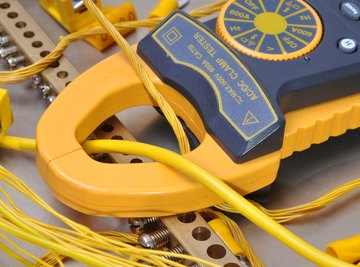
By using a clamp-on ammeter for AC (alternating current) circuits or an inline (series) ammeter for DC (direct current) circuits, you can measure current and use the value of power to convert watts to volts. Follow these steps to find the voltage.
- AC clamp-on ammeter
- DC inline (series) ammeter
Generally, the nameplate of most devices would list all of the above ratings in watts, volts and amperes. Smaller electrical circuits, though, may not list any specifications, and test equipment would be used to find the needed values.
Place the AC ammeter around one of the power wires in an AC circuit. This can be either the hot wire or the neutral common wire in the circuit. Both of these wires will carry the current or amperage for the electrical circuit.
Convert the wattage of 1000 watts into volts for a circuit that has an amperage of 10 amperes. Using the power equation and solving for volts, you end up with:
Divide 1000 watts by 10 amperes and the resultant voltage would equal 100 volts.
Install the inline ammeter into the DC circuit by placing the meter in series with one of the electrical circuit wires. Again this meter can be placed on either the positive (+) wire or the negative (-) wire of the direct current circuit. All power though must pass through the inline series ammeter.
Find the voltage in the direct current circuit of 480 watts with an amperage reading of 15 amperes. Using the translated formula:
Things You'll Need
Tips
References
Tips
- Generally the nameplate of most devices would list all of the above ratings in watts, volts and amperes. Smaller electrical circuits, though, may not list any specifications, and test equipment would be used to find the needed values.