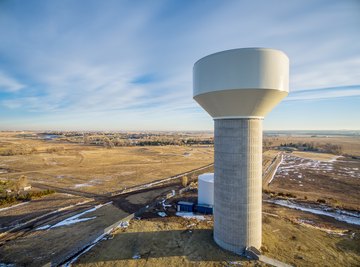

To calculate the pressure at the bottom of your elevated water storage tanks in pounds per square inch is important in many applications, but easy enough to do. You can work this out with a simple rule: 1 foot of water creates 0.433 psi of pressure, and it takes 2.31 feet of water to create 1 psi of pressure. From this, you can work out the psi of any elevated water storage system.
Where P is pressure and h is the height of the water in feet.
TL;DR (Too Long; Didn't Read)
The pressure at any point in the tank is given by 0.433 multiplied by the height of water above it in feet.
Find the height of the water tank by using the gauge on the side of the tank or directly measure the height of tank to find the information you need.
Convert the measurements into feet. If the measurement needs to use inches as well, convert the inches into a proportion of a foot. For example, if the tank is 2 feet and 7 inches, convert the 7 inches by using the fact that there are 12 inches in one foot. In the example:
So 2 feet and 7 inches equals 2.583 feet.
Use the rule that there are 0.433 psi per foot of water to calculate the psi of an elevated water storage tank, or alternatively, the rule that every 2.31 feet of water creates 1 psi. Use the formula for pressure, where h is the height of the water surface in feet and P is the pressure in psi. Simply insert the height measured in the last step into the h position in the formula and evaluate. For example, the psi created by a 100 foot tall water tower can be calculated using the formula:
Although you’ll usually use this formula to find the pressure at the outlet from the tank, you can use it to find the pressure at any point in the tank by calling h the distance from that point in the tank to the water’s surface (in feet).
References
About the Author
Lee Johnson is a freelance writer and science enthusiast, with a passion for distilling complex concepts into simple, digestible language. He's written about science for several websites including eHow UK and WiseGeek, mainly covering physics and astronomy. He was also a science blogger for Elements Behavioral Health's blog network for five years. He studied physics at the Open University and graduated in 2018.