Things You'll Need
Proper housing for the cattle
Feed supplies
Warnings
Keep in mind that all cattle are large dangerous animals. Even though Black Angus cattle are regarded as mild tempered, handlers can be easily injured even if the animal isn't trying to hurt them. If you decide to keep a bull, always give him proper respect and pay close attention to him whenever you are in his presence. Learn cattle behavior and know that otherwise calm and peaceful animals can become dangerous under certain situations such as a new mother protecting a calf and a bull protecting females in heat. Many common injuries happen because handlers let their guard down when handling the cattle.
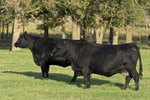
Black Angus cattle are known in the cattle business as "the business breed." In fact, the Mid-Texas Angus Association has that line as its catch phrase. The reason is simple: for anyone raising beef cattle it is the breed that puts the most beef on the hoof with the least work and crossed with other breeds they improve the beef load as well as quality of those breeds, making them a great herd-improvement cross, as well. They are well known for being even tempered and easy to work with.
Decide where you will house animals. There is a wide variety of methods employed by successful cattle ranchers ranging from full enclosures (barns) to open-ended sheds so animals can get out of the elements when they want to, to completely open with only natural shelters such as trees for cover. Depending on where you live some methods will be more successful than others. In warm climates where temperatures are unlikely to dip below freezing, not using any shelter is feasible and helps cut costs. Even if you do not use any housing system you will be better off having a small enclosed area where you can contain a sick animal, or bring in several for observation when necessary. In temperate climates where the temperatures can drop below freezing or extremes in weather are common you should have some type of housing available for your animals.
Pick a method of feeding and care. There are two main methods of raising food-production animals: organic and traditional. Organic methods are becoming very popular, can be more cost effective as well as healthier, but when used in beef cattle production they require a considerable amount of space. The basis for organic production is no chemical additives. That includes feeding methods (which requires any grains fed to also be produced in an organic manner) and health care methods. "Organic" and "range fed" are similar and yet different. Organic refers to the entire method of care using no artificial supplements or chemicals where as range fed simple means fed wholly on grasses and hay rather than using any grain to produce faster gains. While both organic and range fed have attractive properties--marketing to a health-conscious public and a lower cost of production--many commercial producers find it difficult to not use products to help increase yield (meat) without grains or supplements. This is especially true if you're in colder climates where year-round grazing is not available, or your acreage limits the availability of grazing.
Ensure you have either a good quality field for grazing, or additional hay available to your animals at all times, as cows require a constant forage supply to keep their stomachs moving at all times. Their digestive process is a complicated endeavor so if you choose to add grain to increase rate of gain and help keep production animals (pregnant cows, breeding bulls) in peak condition, you will need to supply .5 to 3 lbs. of quality clean grain (oats, corn, barley) per pound of body weight for finishing beef cattle and 4 to 10 lbs. per pound of body weight for production (breeding) animals. This can be quite expensive and cost needs to be considered with a close eye to market value of the meat. The amount of money you spend to add a pound of live weight to your herd must be calculated against the price you will get per pound of hanging weight at time of production.
Develop a good parasite control regimen. Parasite control is vital because a worm load will cause your animals to lose valuable muscle mass, making them commercially less viable as well as decreasing the production ability of your breeding stock.
Start with the best animals you can afford. If you are starting small, or have small acreage, it is best to start with a few cows (females) and use artificial insemination rather than incurring the expense for a top-quality bull along with the extra costs of maintaining a bull year round when you only need him for a few months of the year. Cows do not necessarily have to be purebred, or Angus, if you are just breeding to produce meat production animals. Crossing other breeds with pure Black Angus bulls has shown fantastic results in the quality of meat produced. If you wish to breed animals as replacements or to create purebred animals for sale, the best Black Angus cows are a must.
Keep a close eye on your herd regardless of how big or small it is. It is not enough to buy expensive animals and throw out food daily; successful cattle raisers observe their animals every day, looking for signs of illness, tracking rate of gain, and making daily changes in feed or health care.
Purchase a good management software program. There are many cattle-specific management programs available to help you keep accurate records regarding each animal's tag numbers, birth dates, and individual information on each cow including health records, worming dates and vaccination schedules.
Resources
Warnings
- Keep in mind that all cattle are large dangerous animals. Even though Black Angus cattle are regarded as mild tempered, handlers can be easily injured even if the animal isn't trying to hurt them. If you decide to keep a bull, always give him proper respect and pay close attention to him whenever you are in his presence. Learn cattle behavior and know that otherwise calm and peaceful animals can become dangerous under certain situations, such as a new mother protecting a calf and a bull protecting females in heat. Many common injuries happen because handlers let their guard down when handling the cattle.
Writer Bio
Tami Parrington is the author of five novels along with being a successful SEO and content writer for the past three years. Parrington's journalism experience includes writing for eHow on medical, health and home-related topics as well as writing articles about the types of animals she has raised for years.