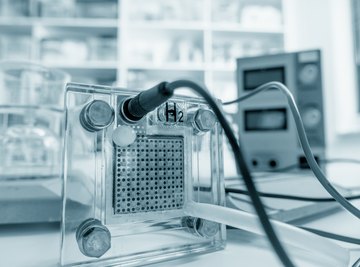

Hydrogen gas has the chemical formula H2 and the molecular weight of 2. This gas is the lightest substance among all chemical compounds and the most abundant element in the universe. Hydrogen gas has also drawn significant attention as a potential energy source. Hydrogen can be obtained, for example, by electrolysis of the water. You calculate the amount of hydrogen in moles either from the gas mass or using the ideal gas law.
Avoid sparks or open flame when working with hydrogen gas, as it is flammable and explosive.
Familiarize yourself with the ideal gas law that is given as PV = nRT; where "P" represents pressure, "V" is volume, "n" is the number of moles of a gas and "T" is temperature. "R" stands for the molar gas constant, which is 8.314472. The gas constant lets you work with the standard units of Kelvins for temperature, moles of gas amount, pressure in pascals and volume in cubic meters.
Add the value 273.15 to the temperature in Celsius (C) to convert it to Kelvin (K).
For example, if the hydrogen was collected at 20C, this temperature would correspond to 293.15 (273.15 + 20) K.
Multiply the pressure commonly expressed in atmospheres (atm) by 101,325 to convert the pressure to the International System of Units pascal (Pa).
For example, if the collected gas is under the pressure of 2 atm, it will convert to 101,325 x 2 atm = 202,650 Pa.
Convert the volume of the collected gas into cubic meters.
For example, if the volume is given in liters (L) divide it by 1,000. Thus, 25 liters corresponds to 0.025 (25 /1,000) cubic meters.
Multiply the volume and pressure and divide the product by the temperature and the molar gas constant to calculate moles of the hydrogen gas.
In the example, the amount of hydrogen is 202,650 x 0.025 / 293.15 x 8.314472 = 2.078 moles.
Use the mass of the hydrogen gas to calculate the gas moles directly; divide the hydrogen weight by its molar mass of 2 g/mole.
For example, 250 grams (g) of the hydrogen gas corresponds to 250 g / 2 g/mole = 125 moles.
Warnings
References
Warnings
- Avoid sparks or open flame when working with hydrogen gas, as it is flammable and explosive.