

How to Calculate the Power of a Hydraulic Cylinder

The primary function of hydraulics is to provide great multiplication of force that is easily transmitted with relatively small mechanical components. A hydraulic cylinder can provide many tons of force at low to moderate speeds, compared to a pneumatic cylinder, which is better at providing low to medium forces at high to moderate speeds, respectively. The empirical product of force and speed is power. Calculating the true power of a hydraulic cylinder requires both variables.
Power-Out Method

-
Determine the force provided by the cylinder. For example, if a 2-inch-diameter hydraulic cylinder lifting a load were supplied with 3,000 pounds per square inch (psi) of hydraulic pressure, you would first calculate the area of the piston in the hydraulic cylinder to determine the overall hydraulic force.
The formula for circular area is pi times radius squared. Multiply 3.1416 times 1 squared, or 3.1416-square-inches (sq.in.). Multiplying the 3,000 psi times 3.1416 sq. in. would equal about 9,425 pounds of linear force provided by the cylinder.
-
Determine the speed of the cylinder, either from excavator specifications or by experimental measurement. In this example, the cylinder pushes out at a rate of 0.5 feet per second while exerting the 9,425 pounds of force.
-
Multiply the cylinder's force by its output speed to determine its power output in foot-pounds per second. 9,425 pounds of force times 0.5 feet per second equals 4,712.5 foot-pounds of work per second.
-
Convert to the desired final engineering units. Divide foot-pounds-per-second work by 550-foot-pounds-per-second-per-horsepower to calculate horsepower (hp). 4712.5 divided by 550 equals 8.57 hp. If kilowatts are desired instead, multiply the horsepower figure by 0.7457 to yield 6.39 kilowatts of power.

Power-Input Method
-
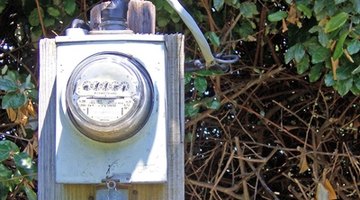
Measure the electrical power consumed by the electrically-driven hydraulic pump motor while the hydraulic cylinder is lifting the load to determine system losses. If a kilowatt meter indicates that the pump motor's power-use rate is 8.45 kilowatts (11.33 horsepower) while the cylinder is providing the 9,425 pounds of force at the 0.5-feet-per-second speed, then power is going into the system that is not coming back out at the cylinder. This power loss is due to losses from hydraulic oil flow restrictions, sliding friction within the cylinder, and friction and electrical losses within the pump and motor.
-
Calculate the system efficiency. Dividing 6.39 kilowatts delivered by the cylinder, by 8.45 kilowatt-hours supplied to the pump multiplied by 100 percent, determines that 75.6 percent of the energy being supplied to the lift is being converted into useful lifting work. This is a reasonable efficiency figure for machines.
-
Use your calculated machine efficiency to calculate the cylinder's power output based on electrical power-input. If the lift uses utility electricity at the instantaneous rate of 9.64 kilowatts while lifting a load with the example cylinder, multiply 9.64 by the 75.6-percent calculated machine efficiency to yield 7.28 kilowatts (9.76 horsepower) of power actually being delivered by the cylinder. If its speed is 0.5 feet per second, the cylinder is lifting a heavier 10,737-pound load this time (7.28-kilowatts divided by 6.39-kilowatts times the original 9,425-pound load). The greater power consumption rate is indicative of the greater weight.
References
Tips
- Use hydraulics for large forces at moderate speeds and pneumatics for lower forces at greater speeds.
- Continuously monitoring machine efficiency helps keep power-hungry equipment operating costs under control.
Warnings
- Hydraulics can produce crushing forces and must be operated cautiously to prevent injury.
- Always use protective eyewear when working with hydraulics.
Writer Bio
Pauline Gill is a retired teacher with more than 25 years of experience teaching English to high school students. She holds a bachelor's degree in language arts and a Master of Education degree. Gill is also an award-winning fiction author.
Photo Credits
- Hydraulic excavator at work. Shovel bucket against blue sky image by Andrei Merkulov from Fotolia.com
- A portable motorised Scissor Lift used by Painters image by david hutchinson from Fotolia.com
- electric meter image by palms from Fotolia.com
- hydraulic machine image by Heng kong Chen from Fotolia.com
More Articles

