Most flowering plants (angiosperms) are monoecious with bisexual flowers, meaning each flower has both male and female reproductive organs. Some species are monoecious with unisex flowers, so each plant has separate male and female flowers, like papaya (Carica papaya). However, around 7% of flower-bearing plants are dioecious, meaning that individual plants within a species only have male flowers or female flowers, like kiwifruit (Actinidia deliciosa).
Male Flower Parts
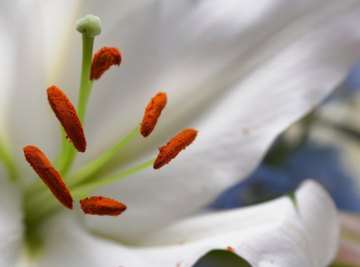
The male part of a flower is called the stamen. Two parts make up the stamen: the anther and filament. The anther is where the pollen, which contains the male reproductive cells or sperm, is created and released when mature. The filament connects the anther to the base of the flower.
Female Flower Parts
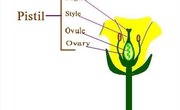
The female part of the plant is called the pistil. Four parts make up the pistil: the stigma, style, ovary and ovules. The stigma is exposed to the open air and has a sticky surface designed to catch pollen. When pollen lands on the stigma, it begins germination, forming long tubes that travel down the style to the flower base, where the protective ovary contains the ovules. The ovules hold the female reproductive gametes for fertilization and nutrients for embryo development.
After fertilization, an embryo develops inside a seed case inside the ovary. The fleshy ovary containing the ovules grows with the developing embryos to become a fruit. The ovary helps protect the seeds during growth, and aids in seed dispersal; how the dispersal happens varies between species.
For example, animal-dispersed fruit may become plump, juicy and delicious, tempting a bird or mammal to eat it; then the seeds are spread to a new location via the feces. In species like gorse (Ulex europaeus) and lupine (Lupinus spp.), the ovaries dry out and then pop open or explode, throwing seeds away from the plant when the weather is hot.
Male Versus Female Flowers
The role of the male flower is to produce pollen and deliver it to a female flower. The role of the female flower is first to produce ovules and receive the pollen for fertilization. Then the female flower must grow new individual plant embryos in seeds, and finally to be a vector to aid the dispersal of the new seeds.
When comparing unisex flowers, the males will usually have many stamens rich with pollen while the females only have pistils. The appearances of pistils and stamens vary between species, however, pollen is often brown or orange, making the anther and filament distinct, while the pistil is usually uniform in color.
Because the female flower has a more involved role in seed development, unisex female flowers are often larger than their male flower counterparts, like in papaya. Another way to tell the difference is that male flowers will never form fruit.
In some species, like kiwifruit, the female flower contains both pistils and anthers, although the anthers don't produce pollen. The male flowers of kiwifruit are distinct as they have only anthers.
Horticulture of Dioecious Plants
As dioecious plants are either male or female, for pollination to occur, there must be both male and female plants in the area. This is especially important in horticulture when the aim is to produce fruit for humans to eat. Typically, fewer male plants are needed than females as the males produce sufficient pollen for multiple plants.
For example, when growing kiwifruit, horticulturists will plant one male plant for every ten female plants. Other horticulturally important dioecious plants include asparagus (Asparagus officinalis), squash (Cucurbita spp.), date palm (Phoenix dactylifera), pistachio (Pistacia vera), nutmeg (Myristica fragrans) and hops (Humulus japonicas, H. lupulus).
References
- Science Learning Hub: Seed Dispersal
- Science Horticulture: Seed Development
- University of Hawaii Cooperative Extension Service: Why Some Papaya Plants Fail to Fruit
- American Museum of Natural History: Parts of a Flower
- Iowa State University: Botanical Terminology: Flowers, Houses and Sexual Reproduction
- 3 Biotech: Sex-oriented Research on Dioecious Crops of Indian Subcontinent: An Updated Review
- Gardening Know How: Kiwi Plant Identification: Determining Sex of Kiwi Vine Plants
Resources
About the Author
Adrianne Elizabeth is a freelance writer and editor. She has a Bachelor of Science in Ecology and Biodiversity, and Marine Biology from Victoria University of Wellington in New Zealand. Driven by her love and fascination with all animals behavior and care, she also gained a Certificate in Captive Wild Animal Management from UNITEC in Auckland, New Zealand, with work experience at Wellington Zoo. Before becoming a freelance writer, Adrianne worked for many years as a Marine Aquaculture Research Technician with Plant & Food Research in New Zealand. Now Adrianne's freelance writing career focuses on helping people achieve happier, healthier lives by using scientifically proven health and wellness techniques. Adrianne is also focused on helping people better understand ecosystem functions, their importance, and how we can each help to look after them.
Photo Credits
Jupiterimages/Photos.com/Getty Images