Things You'll Need
28 oz. refrigerated, filtered water
2-quart heat-resistant glass measuring cup
12 oz. lye
2 silicone spoons
48 oz. vegetable shortening
21 oz. soybean oil
18 oz. coconut oil
4-quart saucepan
Soap-making thermometer
6-quart soap-making pot
Silicone whisk
2 oz. fragrance oil
7-pound soap-making mold
Towels
Knife
2 baker's racks
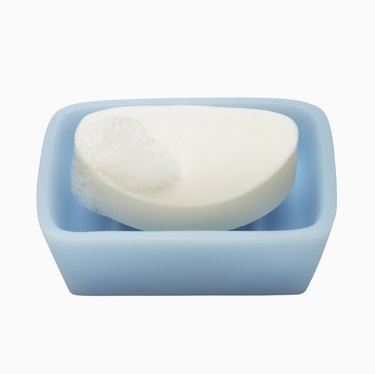
Soap results from the combination of fats or oils and a lye solution. The usual procedure in home soap making is to use a stick blender to mix these two substances in a matter of minutes until they reach a thick consistency known as "trace," which is the beginning of saponification. You can also mix these two substances by hand, although it does take considerably longer to achieve trace. Use a large percentage of solid, saturated fats to make soap by hand-mixing, which achieves trace quicker than other soap recipes that contain primarily liquid, unsaturated oils, as reported on the Cole Brothers website.
Step 1
Pour 28 oz. refrigerated, filtered water into a 2-quart heat-resistant glass measuring cup. Go to a well-ventilated area and slowly pour 12 oz. lye into the water, stirring carefully with a silicone spoon to completely dissolve the lye without splashing it out of the bowl. Set the lye solution aside to cool.
Video of the Day
Step 2
Add 48 oz. vegetable shortening, 21 oz. soybean oil and 18 oz. coconut oil to a 4-quart saucepan. Heat them on the stove over medium heat until all of them melt into a liquid. Stir the oils well. Test the temperature with a soap-making thermometer until it reaches about 100 degrees Fahrenheit. Adjust the heat of the burner to maintain this temperature.
Step 3
Test the temperature of the lye solution. Once it reaches 100 degrees Fahrenheit, pour the heated oils into a 6-quart soap-making pot and slowly mix in the lye solution. Initially mix the lye solution and oils together with a silicone spoon until combined. Continue to mix with a silicone whisk until the consistency reaches that of cake batter, at which point it will achieve trace, turning into soap. This process can take anywhere between 20 minutes and one hour.
Step 4
Add 2 oz. fragrance oil to trace, stirring it in with the whisk to completely combine it into the soap mixture.
Step 5
Pour the mixture into a soap mold, cover it and wrap it in towels for insulation. Let the mold sit for 48 hours.
Step 6
Cut the soap into bars. Place the bars on two baker's cooling racks and let them cure for six weeks. Turn the bars over every week so they cure evenly.
Tip
Weigh all of your ingredients using a digital scale for accuracy. Adjust the measurement for the weight of the container for each item.
This recipe makes 7 pounds of soap.
Warning
Put on a long-sleeve shirt, rubber gloves and a chemical odor mask for safety before handling the lye.
Place the lye solution in an area away from pets and children while it cools.
Keep vinegar nearby when handling lye. If lye gets on your skin, neutralize it with vinegar, not water.
Use stainless steel pots, never aluminum, which can react badly with lye.
Video of the Day
- Soap Making Resource: Cold Process Soap Making Tutorial
- Peak Candle Supplies: Cold Process Soap Making
- Miller's Homemade Soap Pages; All-Vegetable Soaps and Recipes; Kathy Miller
- Skincare Naturals: Soapmaking Safety
- Cole Brothers: Soap Troubleshooting Chart
- SMF Tutorials: Soap Making and Craft FAQ's