
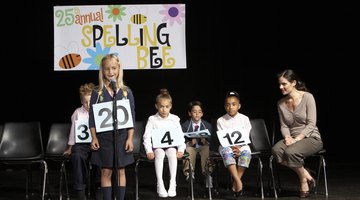


Some parents dream of seeing their children nail the final word at the Scripps National Spelling Bee. Others simply want to see them excel in a classroom showdown. Whatever side of the spectrum you fall on, preparing your child for a spelling bee will be an exercise in determination and resolve. During the hours of study sessions, you will be setting the groundwork for a lifelong love of language and a thirst for achievement.
Sit down with your child and decide how much time he wants to devote to studying. This will depend largely on his level of competition and degree of interest. For those who aspire to the national level, at least two hours a day are necessary. Spelling bees at the school and local level require less preparation, at perhaps a half hour to an hour a day, but a commitment is nonetheless necessary. Make sure your child is prepared to take on this challenge in addition to his regular schoolwork and extracurricular activities.
Gather study materials. The best place to start is with Webster's Third New International Dictionary, Unabridged. Even if your child doesn't plan on perusing the dictionary -- which generally isn't feasible, except for the most advanced-level spellers -- this can serve as the primary resource for looking up words. Students preparing for the Scripps National Spelling Bee can find word lists at the official website (see Resources). Other than that, preparation is up to you and your child. Books that prepare students for the SAT often include lists of challenging vocabulary. You can also find various word lists online, such as at Word-Buff.com.
Teach your child to look for patterns. As your child begins to study, put the focus on looking for patterns of root words. When your child comes across one, such as "tele-" in "telephone" and "telepathy," she should add it to a list just for that root. Each root word on the list should contain the definition and language of origin. That way, if she faces a word in competition that she doesn't know, she may be able to put the sounds together just from hearing the definition and language of origin. Your child should keep a separate list for exceptions to those root rules.
Start a spelling-bee notebook. Buy a binder with dividers for each different type of word your child is studying. For example, the lists of root words can each have their own sections. Your child can also create different sections for words that come from other languages, such as Japanese, Italian and French. Collecting words in this manner will allow your child to see how the sounds of words in other languages are often spelled alike.
Play pronouncer. The most critical preparation for a spelling bee involves practice. Pretend your child is on the stage and ask him to spell the words he has previously studied (or you can also draw straight from the dictionary, to test his ability to figure out roots and remain calm under pressure).
Keep it fun. If you want your child to stay motivated, she has to find a sense of enjoyment in spelling. Many online games are available to serve that purpose, such as the ones at BIGIQKids.com and CoolBuddy.com. The Scripps Spelling Bee video game is also available on the Nintendo Wii.
Related Articles







Writer Bio
April Marie has written and edited for newspapers, magazines and newsletters. She covers business communication, management, technology, art, health and fashion. Marie earned her B.A. in journalism from New York University.