Things You'll Need
Copper tube
Measuring tape
Tubing cutter
Drill with 1/8-inch bit
Rat-tail file
Circular frame
Nylon string or fishing line
Wood disk
Wind catcher
Chromatic Tuner or piano
Sandpaper or grinder
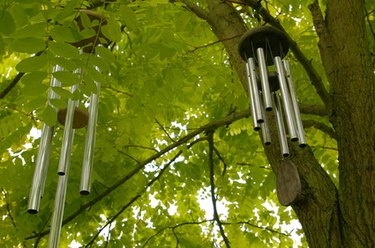
The pentatonic, or five-note, scale is commonly used in a variety of musical styles. The notes in a pentatonic scale will produce a pleasant sound regardless of what order they are played. Since wind chimes sound in random order, use of this scale is ideal. The tone of each tube is determined by its length and thickness. Tuning your chimes will take time and patience but you will be able to enjoy the finished project for years.
Step 1
Measure and cut your tube sections. A 27-inch length of one-inch, type M copper pipe will produce a tone equivalent to middle C on a piano. For a major pentatonic scale with a root note of C, the tones should be C, D, E, G and A. The remaining tube lengths should be: D = 25 8/16; E = 24 1/16; G = 22 1/16; A = 20 13/16.
Video of the Day
Step 2
Drill a 1/8-inch hole through each pipe at its end node. The node is the point at which the least vibration occurs. This is located 22.4 percent from the end of the pipe. For the pipes listed in step one the nodes are: C = 6 1/16; D = 5 11/16; E = 5 6/16; G = 4 15/16; A = 4 11/16.
Step 3
Remove any sharp edges or burrs from the inside of your drilled holes with a rat-tail file.
Step 4
Attach the chimes to the frame with nylon string or fishing line. Space the chimes as evenly as possible around the frame.
Step 5
Drill a 1/8-inch hole through the center of your wood disk. Thread a piece of nylon string or fishing line through the hole and attach the top of the string to the center of your frame.
Step 6
Adjust the height of the disk to strike as close to the bottom of the chimes as possible. Tie a knot underneath the disk to hold it in place and attach your wind catcher to the end of the string. The wind catcher should hang at least six-inches below your lowest hanging chime.
Step 7
Tune your chimes by striking them one at a time near the middle. Compare the tone with the chromatic tuner or piano. Sand or grind a bit off the bottom of the pipe to raise the pitch.
Tip
You can only raise the pitch of a length of cut pipe, if exact pitch is important to you, make your initial cuts 1/16-inch longer than the dimensions listed above. Then sand or grind them until they are in tune.
A wind catcher can be made from almost any material. An unwanted compact disc is a quick and easy-to-mount wind catcher.
You can make a pentatonic wind chime in any key. The intervals for a major pentatonic scale are: 2-2-3-2-3. The intervals for a minor key are: 3-2-2-3-2. Intervals are single steps in the chromatic scale.
Video of the Day