

Homemade on Demand Water Heater

On-demand water heaters have become cheaper and more widespread, and because of their energy efficiency, they tend to be cost effective for single-family use. But the devices themselves can nevertheless be fairly expensive. As an option to an expensive manufactured model, build your own on-demand water heater using either electricity or natural gas.
How It Works
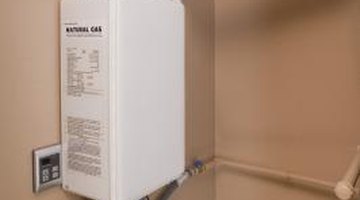
The core principle behind water heating in general is to transfer a large amount of heat energy to a supply of water via a heat exchanger. The key difference between an on-demand water heater and a traditional water heater is that, as its name implies, an on-demand water heater produces hot water more or less instantly in the desired amount and thus requires no storage tank. On-demand water heating requires a large, fast transfer of energy. However, on-demand water heaters are actually more efficient than their traditional tank counterparts in most single-family homes, because the energy costs of heating water rapidly a few times a day are outweighed by the energy savings of not having to maintain a tank of hot water around the clock. Some can also save water, because when placed properly, they don't require running colder water in the pipes down the drain to get to the hot water.
Energy Sources
Two common home energy sources are up to the task: electricity and natural gas. Electricity is the safer of the two. It's also usually more expensive, depending on local energy prices and whether your gas is supplied by refillable tanks (as in many rural areas) or underground mains (as in municipalities and other urbanized areas). Environmentally, electricity is preferable to gas unless the source is a coal-fired power plant. However, if many people were to use electric on-demand water heaters at the same time of day (for showering in the morning, for instance), it would produce peak-demand problems that could actually negate the energy benefits of an on-demand.
Safety
With electricity, design a water heater that has little or no risk of passing an electrical shock through the water to the person using it. With gas, prevent the risk of fire or explosion, and ensure the proper ventilation of the area around the water heater. Either way, proceed with a DIY water heater only if you understand how to address the safety risks.
Heat Exchanger
A “heat exchanger” is not a specific device, but a system of heat transfer. Thus, you can choose from many different kinds of heat exchangers. For this application, buy one from the hardware store or build one from scratch. To heat the water quickly, you will need to maximize its surface area in a small space. This suggests the use of a coiled tube, which is then exposed to the heat source. If you're using electricity, wrap the coil with a heating element. If you're using gas, place the coil around and above the flame, installing a pilot light as well as a vent.
Method
Build two pathways to complete your water heater.
First, provide a pathway for the incoming cold water line to come in contact with the heat source and then emerge as a hot water line. To avoid heat loss, make sure you place the water heater near to where the hot water will be used.
Second, provide a pathway for the energy source. If you use electricity, bring in the hot and neutral (and ground) lines of a circuit, and connect them to the heat exchanger. If using natural gas, provide a pathway from the tank or the pipe to a terminal point at the heat exchanger where the flame will be ignited.
Prior to building the actual water heater, run a test (or do some calculations) to see what flow of electricity or gas you will need to transfer enough energy to heat a continuous stream of cold water to the desired temperature range in the amount of time available. Also note that if your cold water is not consistent in temperature, your hot water will not be consistent either. You may therefore need to increase the heat transfer rate during the winter months, and decrease it in the summertime.
References
Writer Bio
Josh Fredman is a freelance pen-for-hire and Web developer living in Seattle. He attended the University of Washington, studying engineering, and worked in logistics, health care and newspapers before deciding to go to work for himself.
Photo Credits
- Jupiterimages/Comstock/Getty Images
More Articles

