

Old Toilets Vs. New Toilets

Toilets employ simple operating methods, in both new and older models, although some innovations have changed the manner in which new toilets flush compared to their older counterparts.
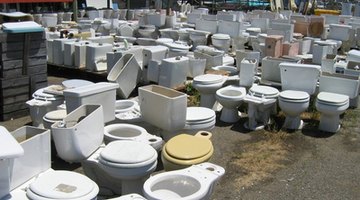
Other changes, such as the amount of water usage and the placement of toilets in relation to the wall, create differences between new and old toilets.
Rough-in Differences
The toilet's rough-in is an important consideration. The rough-in is the distance from the finished wall behind the closet flange to the flange's center point. The flange rests on top of the drain pipe and the toilet is installed on top of it. This rough-in measurement must match the toilet's rough-in specifications for the toilet to fit properly. New toilets normally have a 12-inch rough-in, compared to the 10-inch or 14-inch rough-in dimensions that old toilets usually have.
Water Usage Differences
According to the U.S. Environmental Protection Agency, the flushed water from toilets accounts for almost 30 percent of a household's total indoor water use. Old toilets use more water than new toilets. Flushing a toilet used 7 gallons of water or more per flush, before the 1950s. As recently as the 1980s, toilets still used about 3.5 gallons of water for each flush. In 1995, federal law mandated that all new toilets in the United States can use only up to 1.6 gallons of water per flush.
Fill Valve Differences
The fill valve allows water into the toilet tank. This job, in both old and new toilets that rely on gravity to pull the water and waste through the system, is exactly the same. However, the design of the valve itself has changed. Look inside the tank of an older toilet and you often find a float ball that is attached to an arm leading back to the ballcock. In new toilets, this fill valve normally has a float cup attached to the valve, without the long horizontal arm.
Flushing Differences
New toilet choices include a power flush system. In this system, the tank water is stored within an air-filled pressure tank that is found within the larger china tank. When the toilet is flushed, the water is pushed with force down through the bowl. Also, some new toilets have dual flush technology, which allows you to flush the toilet using two different amounts of water, depending on how much is needed for a particular flush.
References
Writer Bio
Christopher John has been a freelance journalist since 2003. He has written for regional newspapers such as "The Metro Forum" and the "West Tennessee Examiner." John has a Bachelor of Arts in journalism from Memphis State University.
Photo Credits
- salvage yard with vintage toilets image by DSL from Fotolia.com
- salvage yard with vintage toilets image by DSL from Fotolia.com
More Articles

