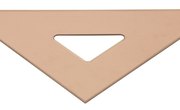
In geometry, triangles are shapes with three sides that connect to form three angles. The sum of all angles in a triangle is 180 degrees, meaning that you can always find the value of one angle in a triangle if you know the other two. This task is made easier for special triangles such as the equilateral, which has three equal sides and angles and the isosceles, which has two equal sides and angles. It's also helpful to know triangle formulas which can help you determine attributes of a triangle, such as the length of its sides and its area.
Calculating Sides of Right Triangles
Recall the Pythagorean Theorem. You can calculate the length of any side of a right triangle if you know the lengths of two sides using the pythagorean theorem. In addition, you can determine if a triangle has a right angle (90 degrees) if it satisfies the theorem, a^2 + b^2 = c^2 ("a" squared plus "b" squared equals "c" squared, where "c" is the longest side of the triangle and the side opposite of the right angle.)
Input the lengths of triangle sides you know. For instance, if you are asked to find the length of a hypotenuse (the longest side of the right triangle) of a triangle where one side (a) equals 2 and another side (b) equals 5, you can find the length of the hypotenuse with the following equation: 2^2 + 5^2 = c^2.
Use algebra to find the value of "c." 2^2 + 5^2 = c^2 becomes 4 + 25 = c^2. This then becomes 29 = c^2. The answer, c, is the square root of 29 or 5.4, rounded to the nearest tenth. If you are asked to determine whether a triangle is a right triangle or not, input the lengths of the triangle into the Pythagorean theorem. If a^2 + b^2 does, in fact, equal c^2, then the triangle is a right triangle. If the equation does not balance out on both sides of the equal sign, it cannot be a right triangle.
Calculate the Area of a Triangle
Use the equation for the area of a triangle. You can find the area of any triangle when you know that it is equal to one half the base times height of the triangle. The equation is A = (1/2)bh, where b (base) is the horizontal length of the triangle and h (height) is the vertical length of the triangle. If you imagine the triangle sitting on the ground, the base is the side that touches the floor and the height is the side that stretches upward.
Substitute the lengths of the triangle into the equation. For instance, if the base of the triangle is 3 and the height is 6, the equation for the area becomes, A = (1/2)_3_6 = 9. Alternatively, if you are given the area and base of a triangle and asked to find it's height, you can substitute the known values into this equation.
Solve the equation using algebra. Suppose you know that the area of the triangle is 50 and it has a height of 10, how might you find the base? Using the equation for the area of a triangle, A = (1/2)bh, you substitute the values to get 50 = (1/2)_b_10. Simplifying the right side of the equation, you get 50 = b*5. You then divide both sides of the equation by 5 to get the value of b, which is 10.
References
About the Author
Iam Jaebi has been writing since 2000. His short story, "The Alchemist," reached over 250,000 readers and his work has appeared online in Thaumotrope and Nanoism. His novel, "The Guardians," was released in 2010 by Imagenat Entertainment. Jaebi is also a business writer specializing in company naming, concept designs and technical writing. He graduated from Syracuse University with a Bachelor of Science in computer engineering.
Photo Credits
Jupiterimages/Photos.com/Getty Images