
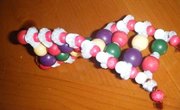
Popsicle sticks make a great material for creating DNA models. The shape of DNA is a double helix, which is like that of a twisted ladder. The outside of the helix is the DNA's structural backbone, made of sugar and phosphate groups. The inner rungs of the DNA are the nucleotides thymine, cysteine, guanine and adenine.
- Popsicle sticks
- Black acrylic paint
- Red acrylic paint
- Blue acrylic paint
- Yellow acrylic paint
- Green acrylic paint
- Paintbrush
- Fine-tipped black permanent marker
- Utility Knife
- Hot glue gun
- Hot glue sticks
Create models that show mutations or translocation abnormalities in nucleotide sequences. Extend your model project by writing a research paper about DNA.
Only adults should use the utility knife.
Paint 12 popsicle sticks black with acrylic paint and brush. Allow to dry for one to two hours.
Paint three popsicle sticks red, three popsicle sticks green, three popsicle sticks yellow, and three popsicle sticks blue. Allow to dry for one to two hours.
Use hot glue to affix six black popsicle sticks together lengthwise, at the ends, to create a long line. Repeat with the remaining six black posicle sticks. You should have two long pieces of black popsicle sticks. These sticks represent your sugar phosphate DNA backbone.
Create nucleotides by labeling colored popscicle sticks using a fine-tipped black permanent marker. Neatly write "adenine" on both ends of all of the red sticks. Write "thymine" on both ends of all blue sticks. Write "guanine" on the ends all yellow painted popscicle sticks. Finally, write "cystine" on each end of all three green popscicle sticks.
Cut each red, green, blue and yellow popscicle stick in half using a utility knife. To do this, score the sticks in the center with the knife, and then gently snap the stick in two using your hands.
Hot glue all red adenine nucleotide stick halves to the blue thymine stick halves to represent nucleotide base pairing. Adenine always pairs with thymine in DNA.
Hot glue all yellow guanine nucleotide stick halves to the green cytosine stick halves to represent nucleotide base pairing. In DNA, guanine always pairs with cytosine.
Lay the two long pieces of the black painted popscicle sticks in front of you. Position them parallel and wide enough apart from each other to fit in the other painted sticks.
Hot glue alternating nucleotide combinations on the inside of the long black sticks from end to end to create a ladder shape.
You can use extra popscicle sticks to spell out "DNA Molecule" to create a title display for your model.
Things You'll Need
Tips
Warnings
References
Tips
- Create models that show mutations or translocation abnormalities in nucleotide sequences.
- Extend your model project by writing a research paper about DNA.
Warnings
- Only adults should use the utility knife.
About the Author
Ana Ulrich's passions are environmental education, environmental advocacy, and natural science. She is a highly certified science teacher and professional writer, editor and subject matter expert in her field. In her spare time, she is always outdoors; focusing on building strong relationships between the community and natural ecosystems.
Photo Credits
DNA 3 image by chrisharvey from Fotolia.com