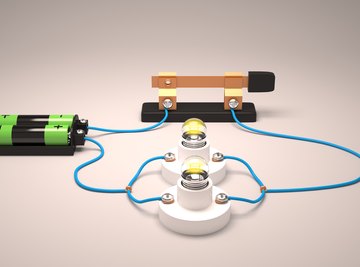

A parallel circuit has one function: to keep the electricity flowing when one pathway is interrupted. A prime example is light fixtures that use multiple light bulbs. When a single bulb in the fixture goes the light fixture continues to operate. This is because, at each light receptacle, there is a parallel circuit that allows the electricity to flow around the inoperative bulb. Parallel circuits allow us to route electricity through multiple parts in electronic assemblies.
How to Build a Parallel Circuit
Strip the ends of 2 pieces of wire. Attach one end of one wire to the positive ("+") pole of a small direct current (DC) power source, like a battery, and connect one end of the other wire to the negative ("-") pole of the battery. Connect one wire from each of two 1.5 VDC "grain of wheat" (GOW) bulbs to the wire that is attached to positive pole of the battery. Connect the second wires from the two GOW bulbs together and connect those two wires to the wire connected to the negative side of the battery. Both bulbs will burn.
How the Parallel Circuit Works
Like a river that forks, then rejoins on the other side of an island, the parallel circuit carries electricity in both of its branches. Like the river, the power is slightly diminished, but the electricity flows through both branches.
In the event that one branch of a river is disrupted, perhaps by being dammed up, the river still flows through the other branch. Likewise, should the circuit on one branch of the parallel circuit be interrupted--by a broken light bulb, for example--the other side of the parallel circuit will continue to function normally.
Uses in a Digital World
Possibly, the most familiar use of parallel circuits is found in lighting fixtures: if one bulb burns out, the other bulbs in the fixture continue to operate. Other uses include an electronic OR gate, where two switches are in a parallel circuit: one of the switches must be closed for the circuit to function. If both sides are closed, the circuit will not function.
Household wiring is a series of parallel circuits. Otherwise, if you were to turn your oven (or television, or your computer, or any other appliance off, the rest of your home's electrical system will cease to operate.
References
About the Author
Will Charpentier is a writer who specializes in boating and maritime subjects. A retired ship captain, Charpentier holds a doctorate in applied ocean science and engineering. He is also a certified marine technician and the author of a popular text on writing local history.