

How to Identify Worms on a Live Oak Tree

Live oaks are hardy trees, capable of surviving most pests and blights. However, an attack by insects can quickly remove leaves from your tree, causing it undue stress and making it susceptible to further damages. Almost all the worms that attack live oaks are caterpillars.
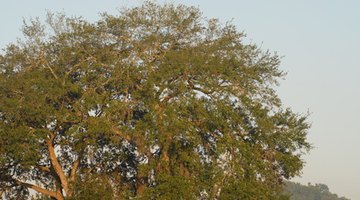
Bringing the pests under control can not only boost the health of your tree, but also improve its appearance. While most caterpillars are not a serious threat to a live oak, many of them create unsightly webs and cocoons that can detract from the enjoyment of your landscape.
Things You Will Need
- Magnifying glass
- Piece of white cardboard
Tip
Oak leaf rollers normally hatch in March and begin feeding on your tree's new leaves. By the end of April, they have usually entered the cocoon stage, and you will see the pupae hanging onto the tips of small twigs on your tree or other plants nearby. The looper, or oak leaf roller, often falls onto people walking under the branches of the tree. The season for the orange-striped oakworm is normally between August and October. The moths lay their eggs in a cluster on the underneath side of a leaf, normally on a low branch. When mature, orange-striped oak worms are 1 1/2 to 2 inches long. The head is dark black surrounded by vivid yellowish orange. The next section of the body has two horns or black spines. The most serious threat to your tree is the carpenter worm, which can reach lengths of 2 to 3 inches. You may never see one of these pests, because they burrow into the heart of the tree. Instead, look for sap spots. If you are still having problems identifying what is attacking your live oak tree, consider contacting your local extension office. They can advise you which pests are currently active in your area.
-
Examine your tree for sap spots, caterpillars, moths or bore holes in the wood. Also look for eggs laid on the underside of leaves on low branches. These are all signs of oak worm infestation.
-
Secure a sample of a caterpillar for examination, and place it on a piece of white cardboard for best contrast. Use a magnifying glass to examine the caterpillar. Make a note of the coloration of the pest and all its distinctive features.
-
Match your findings to the following descriptions: If the caterpillar is milky white to pale green with a head that is either brown or black, it is most likely the looper, or oak leaf roller. If your specimen is charcoal in color with yellow-orange stripes, it may be the orange-striped oakworm. If your sample is greenish white with a dark brown head, a hairy body and hooked legs, it may be a carpenter worm.
The Drip Cap
- Live oaks are hardy trees, capable of surviving most pests and blights.
- While most caterpillars are not a serious threat to a live oak, many of them create unsightly webs and cocoons that can detract from the enjoyment of your landscape.
- Match your findings to the following descriptions: If the caterpillar is milky white to pale green with a head that is either brown or black, it is most likely the looper, or oak leaf roller.
References
Writer Bio
Nadia Jorney has been writing all her life, but professionally since 1985. She has authored numerous poems, short stories, and novels under a variety of pseudonyms.
Photo Credits
- green oak tree image by jimcox40 from Fotolia.com
- green oak tree image by jimcox40 from Fotolia.com
More Articles

