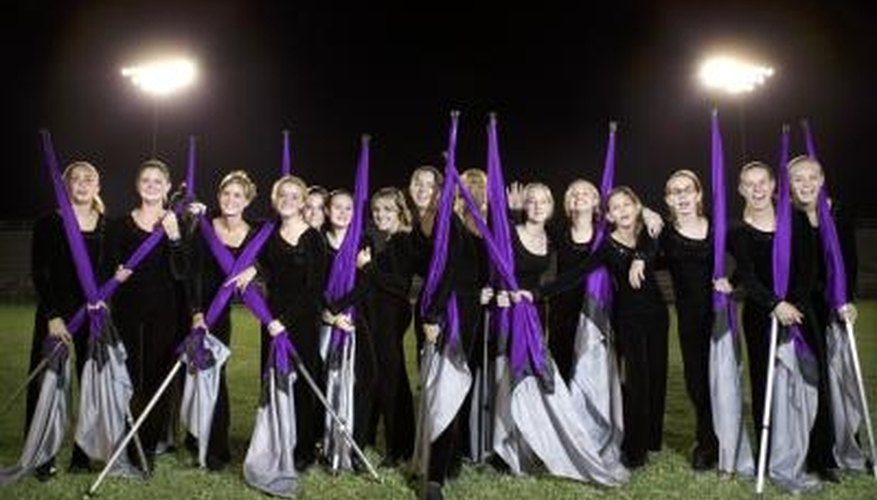


Getting started in a color guard can be a bit overwhelming. At first, you may not know what you are doing, or where you should get your supplies. Other members of your team and instructors can be a great resource for information tailored to your team and location. But if you're considering joining a color guard, having an idea of what supplies you'll need, the logistics of some basic moves and other beginner's information can help you decide if color guard is right for you.
Color Guard Equipment
Color guards are known for spinning flags. These are usually six foot metal poles with flags about three feet long. Swing flags are smaller flags, usually used in pairs. More experienced spinners work with rifles and sabers, referred to as weapon line. Some instructors will get creative and use everyday objects like PVC pipe to create poles for spinning or even have members spin with things like briefcases.
Necessary Gear
Gloves for spinning is a must. You can pick up gloves at most sports stores and even large superstores. These gloves are usually fingerless, with leather hands and mesh on the top of the palm. Weightlifting gloves tend to fit the needs of most spinners. Electrical tape also comes in handy, as it secures flags to poles and can be used to cover weapons. You'll also need a bag for carrying all your equipment. Specially designed bags are available for flags and weapons, but another solution is a ski bag. Ski bags are usually tall enough for six foot flags and have compartments for weapons and smaller supplies.
Basic Moves
The first thing most guard members are taught is called right shoulder. This position has the flag straight up and down, with your left hand at the bottom of the flag pole and your right hand at the end of the flag silk, usually marked by a piece of electrical tape. Your left hand will be at your belly button and the right in front of your face. Next, most color guards teach a move called a drop spin. The drop spin is what many moves are based on. A drop spin begins at right shoulder. Let go of the flag with your left hand, and rotate the flag downward with your right, moving counter clockwise. Your right hand will be upside down, with your palm facing outward. Without removing your right hand, put your left hand on the pole right beneath it. Your palm should be facing outward, with your thumb pointing down. Let go of the flag with your right hand and twist counterclockwise with your left until the flag is facing upward. Place your right hand back onto the pole like you would for right shoulder, but underneath your left hand. These motions create a drop spin. Both of these movements can be mimicked on the left with hands reversed and are the foundations of almost every move.
Tosses
Tosses take experience and practice, but the basic toss is one all color guard members learn to achieve. You begin at right shoulder, then, keeping the flag facing flat to the front, drop the pole to a 45 degree angle, flag pointing downward on your right. Once in position, push down with your left arm and push upward with your right at the same time. This should send the flag spinning counterclockwise into the air. The direction your right arm is pointing is where the flag is going to fly, so as you practice, keep an eye out. Your flag won't go straight up and down the first few times, as you might not be keeping your arms pointed upwards.
Charts
For color guards working with a marching band, you will have to learn how to read charts to find your positions on the field. These charts are usually marked by numbers signifying different members of the band and color guard on a small scale drawing of a football field. Each chart, based on counts of music, gives you a certain amount of counts to move from one position on the field to the next. Your instructors will help you learn how to read the charts based on your color guard's specific needs.
References
Writer Bio
Kelly Wall has been writing news articles since 2007. Her work has been published in "The Informer." She graduated from the University of Hartford in December 2009 with a Bachelor of Arts in international studies and minors in communications and Spanish.