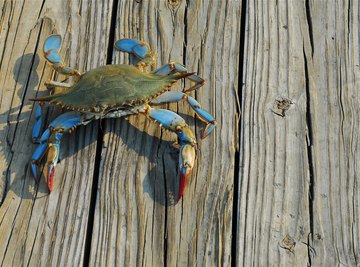

Crabbing is a huge part of the culture in the Southern United States. Blue crabs, in particular, are popular because they're known as easy to catch and their numbers are continually rising in a number of U.S. states, including Florida. They're also prized for their delicious meat and their beautiful sapphire shells.
As with most fishing and hunting, there are certain rules and regulations you must follow when trying to catch blue crab. You'll also need to know details on blue crab habitat, behaviors and how to craft a blue crab trap before you can start planning your crab dinner.
Blue Crab Classification
The blue crab, known by its scientific name Callinectes sapidus, is a marine invertebrate that can be found in a huge range from Nova Scotia all the way down the East Coast of the United States to the Gulf of Mexico and all the way down to the waters off of Uruguay.
While they are called blue crabs, their entire shell isn't really blue. It's their large claws that have the blue coloration. Their main "body" shell is more of a green color. Females also have spots of red at the end of their claws.
Blue Crab Season Florida
The range of blue crabs, as said earlier, can be as far north as Nova Scotia down to the southern reaches of Uruguay. This shows that these crabs are versatile enough to live in waters of various temperature. However, they do prefer warmer waters and are often found in larger populations in areas with warm water.
It's for that reason that many fishers and hunters consider spring and summer months to be the true blue crab season (Florida or otherwise).
Florida Crabbing Regulations
In efforts to maintain populations and to avoid over-fishing (or over-crabbing, in this case), there are regulations that are in place. The first is that anyone over age 16 needs to apply for and complete a free online blue crab fishing and trapping registration form/license. This is in efforts to track just how many people are fishing for blue crab.
There are also very specific trap regulations that control the size, measurements and components of the blue crab trap. Look at those specific requirements here. If you're caught not following regulations or caught trapping without registration/license, you could be fined.
Catching Female Blue Crabs
One of the most important regulations has to do with catching female crabs. It's not illegal to catch and keep female crab in general, but it is illegal to catch and harvest female crabs that are egg-bearing. This is another effort to conserve the population of crab in Florida. And while it isn't illegal to take non-egg-bearing females, many crabbers will release them anyway.
The following are some other Florida blue crab regulations to keep in mind:
- You're only allowed to harvest 10 gallons per day.
- Each person can only own five legal crab traps.
- Traps must be manually pulled.
- You can only pull up traps during daylight.
Tips to Catch a Blue Crab
Legal traps can be purchased from almost any outdoor store. A lot of different bait types can be used to catch blue crab since they're omnivorous and often scavenge and eat anything they can find. Many fishermen and crab trappers suggest using oily and particularly pungent bait as these can lure crab more easily to the trap.
Common bait for blue crab include:
- Fish heads
- Squid
- Oily fish such as mullet
- Chicken necks
Once the trap and bait is bought and assembled, it's time to set the traps. Crabbers suggest going in the early morning hours and/or around high tide. Many of the larger male crabs (the best to catch, as they have the most meat) prefer still and/or shallow water. They're also often found near marshes and estuaries.
References
About the Author
Elliot Walsh holds a B.S in Cell and Developmental Biology and a B.A in English Literature from the University of Rochester. He's worked in multiple academic research labs, at a pharmaceutical company, as a TA for chemistry, and as a tutor in STEM subjects. He's currently working full-time as a content writer and editor.