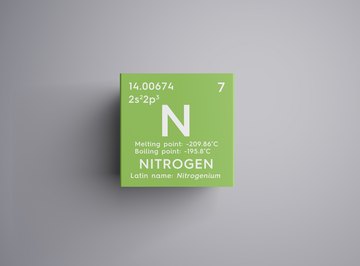

To solve isotopic abundance problems, the average atomic mass of the given element and an algebraic formula are used. Here is how you can do these types of problems.
Relative Abundance Chemistry
The relative abundance definition in chemistry is the percentage of a particular isotope that occurs in nature. The atomic mass listed for an element on the periodic table is an average mass of all known isotopes of that element.
Remember that as the number of neutrons changes within the nucleus, the identity of the element remains the same. A change in the number of neutrons in the nucleus denotes an isotope: nitrogen-14, with 7 neutrons, and nitrogen-15, with 8 neutrons, are two different isotopes of the element nitrogen.
To solve isotopic abundance problems, a given problem will ask for relative abundance or the mass of a particular isotope.
Step 1: Find the Average Atomic Mass
Identify the atomic mass of the element from your isotopic abundance problem on the periodic table. Nitrogen will be used as an example: 14.007 amu.
Step 2: Set Up the Relative Abundance Problem
Use the following formula for relative abundance chemistry problems:
(M1)(x) + (M2)(1-x) = M(E)
- M1 is the mass of one isotope
- x is the relative abundance
- M2 is the mass of the second isotope
- M(E) is the atomic mass of the element from the periodic table
Example problem: If the masses of one isotope of nitrogen, nitrogen-14, is 14.003 amu and another isotope, nitrogen-15, is 15.000 amu, find the relative abundance of the isotopes.
The problem is asking to solve for x, the relative abundance. Assign one isotope as (M1) and the other as (M2).
- M1 = 14.003 amu (nitrogen-14)
- x = unknown relative abundance
- M2 = 15.000 amu (nitrogen-15)
- M(E) = 14.007 amu
When the information is placed into the equation, it looks like this:
14.003x + 15.000(1-x) =14.007
Why the equation can be set up this way: Recall that the sum of these two isotopes will equal 100 percent of the total nitrogen found in nature. The equation can be set up as a percent or as a decimal.
As a percent, the equation would be: (x) + (100-x) = 100, where the 100 designates the total percent in nature.
If you set the equation as a decimal, this means the abundance would be equal to 1. The equation would then become: x + (1 – x) = 1. Note that this equation is limited to two isotopes.
Step 3: Solve for x to Get the Relative Abundance of the Unknown Isotope
Use algebra to solve for x. The nitrogen example is done in the steps below:
- First, use the distributive property: 14.003x + 15.000 - 15.000x = 14.007
- Now combine like terms: -0.997x = -0.993
- Solve for x by diving by -0.997
x = 0.996
Step 4: Find percent abundance
Since x = 0.996, multiply by 100 to get percent: nitrogen-14 is 99.6%.
Since (1-x) = (1 - 0.996) = 0.004, multiply by 100: nitrogen-15 is 0.4%.
The abundance of the nitrogen-14 isotope is 99.6 percent, and the abundance of the nitrogen-15 isotope is 0.4 percent.
Calculating Relative Abundance in Mass Spectroscopy
If a mass spectrum of the element was given, the relative percentage isotope abundances are usually presented as a vertical bar graph. The total may look as if it exceeds 100 percent, but that is because the mass spectrum works with relative percentage isotope abundances.
An example will make this clear. A nitrogen isotope pattern would show a 100 relative abundance for nitrogen-14 and 0.37 for nitrogen-15. To solve this, a ratio such as the following would be set up:
(relative abundance of isotope on spectrum) / (sum of all relative isotope abundances on spectrum)
nitrogen-14 = (100) / (100 + 0.37) = 0.996 or 99.6%
nitrogen-15 = (0.37) / (100 + 0.37) = 0.004 or 0.4%
References
Resources
Tips
- *You may receive a question involving more than two isotopes of an element. For example, tin has 10 isotopes. You can only solve for two variables at a time, so the question will need to give you the percent abundances of all but two of the isotopes.
- *The test question might round the isotope weights differently. For example, the precise weight of N14 to six decimal places is 14.003074 amu, and that of N15 is15.000109 amu. Although this would make the algebra a little messier, it doesn't change the way you solve the question.
About the Author
Rosann Kozlowski is currently a freelance writer and tutor. She has a Master's Degree in Chemistry from the University of Oregon and has previously worked in the pharmaceutical industry and has taught at the middle school, high school, and college levels.