
How to Discover an Atomic Structure

How to Discover an Atomic Structure thumbnail
It is necessary to understand the properties of the individual atoms before discovering the corresponding atomic structure.

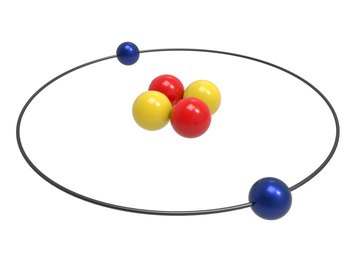
The atomic structure refers to the organization of the subatomic particles within the element. These subatomic particles consist of protons, neutrons and electrons. Depending on the type of element that you are contending with, the number of protons, neutrons and electrons will be different. Therefore, even though all elements have the same general atomic structure, with the protons and neutrons located in the nucleus, and the electrons present within the electron cloud, it is still necessary to understand the properties of the individual atoms before discovering the corresponding atomic structure.

Things You'll Need

  • Periodic table
Show More

Instructions

    • 1

      Find the element on the periodic table. The periodic table is a beneficial reference to use when attempting to discover the atomic structure of an element because it will indicate the number of subatomic particles, as well as the number of valence electrons. The number situated above the element is the atomic number. This number indicates the number of protons within the element. For neutral atoms, the number of protons equals the number of electrons. The number of neutrons can be determined by subtracting the number of protons from the atomic mass of the element.

    • 2

      Comprehend the proper positions of the subatomic particles. The neutrons and protons are located in the nucleus of the atom, which composes the center of the atom. The nucleus is very dense and compact. The electrons are located in abstract electron clouds. Electron clouds represent the probability of where the electrons are most likely to be found. The electrons occupy much more space than does the nucleus of the atom.

    • 3

      Estimate the general size of the radius of the atom. Discovering the atomic structure can be accomplished by having an understanding of the size of the radius. The periodic table is also beneficial for this process because it possesses trends that facilitate this. The trend of atomic radius is that the size of the radius tends to increase as you move toward the left of the table, and that the size of the radius increases as you move down the periodic table. Atoms with a smaller atomic radius are smaller than those with a larger atomic radius.

Related Searches:

References

  • Photo Credit atom_topaz image by Sergey Tokarev from Fotolia.com

Comments

You May Also Like

  • How to Split an Atom

    In 1932, physicists Sir John Douglas Cockcroft and Ernest Walton split atoms of lithium into helium nuclei, followed two years later by...

  • What Is the Structure of an Atom of Uranium?

    When most people the word "uranium," the first thought is often of military applications and atomic bombs. But what exactly is it...

  • Teaching Tips on the Atomic Structure

    Teaching atomic structure can be a challenge. The quantum mechanical picture of the atom is complicated and very abstract --- so abstract,...

  • How to Find the Ionic Radius

    Ions are atoms that carry a charge. Ions can be positively or negatively charged based on the number of electrons in their...

  • Information on The Atomic Structure of the Element Cesium

    Cesium is an element that is located on the first column of the sixth row of the Periodic Table of Elements. Robert...

  • Who Discovered the Nucleus?

    Ernest Rutherford, considered the father of nuclear physics, was given this title for his discovery of the nucleus. Rutherford put forth the...

  • About Atomic Structure

    The atom is the building block that makes up our diverse universe. Once though to be the smallest unit of matter we...

  • What Does the Structure of an Atom Look Like?

    Although atoms cannot be divided without altering their chemical nature, they have subatomic structures. The structure of an atom is composed of...

  • Atomic Structure Tutorial

    Toward the end of the 19th century some remarkable discoveries were made that revealed the complexity of an atom and revolutionized the...

  • Discovery of the Proton & Neutron

    Protons and neutrons are both subatomic particles found in the nucleus of an atom. Together, protons and neutrons are known as nucleons....

  • How to Convert Atoms to Grams

    Converting atoms to grams is an essential process in basic chemistry and forms the foundation for the more difficult calculations used in...

  • How to Draw the Atomic Structure of Atoms

    Drawing atomic structure requires only a simple understanding of the components of atomic structure. If you understand how protons and electrons relate...

  • Levels of Organization of a Cell Tissue

    The atom is the simplest complete particle known to man. Defined as the smallest possible representation of an element that still maintains...

  • Atomic Structure Facts

    The atom is largely empty, with most of its mass concentrated in the center. Positively charged protons in the nucleus attract negatively...

  • Atomic Structure of Uranium

    Uranium, a rare earth element, was identified in the late1780s and named after the planet Uranus. It was used by the ancients...

  • The Structure of Atoms

    The atom is mostly vacuum, its mass concentrated in the neutron- and proton-filled nucleus. Quantum mechanics describes the strange behavior of matter...

  • What Does the Structure of an Atom Look Like?

    The structure of an atom consists primarily of three parts, including neutrons, protons and electrons. Find out how the main component of...

  • How to Find the Radius of a Corner

    Many products are sold by the square foot and require you to calculate a square area (for example, carpet, wood flooring or...

  • How to Build the Atomic Structure of Helium

    Atom models represent the three main parts of an atom: protons and neutrons--which combine to make the nucleus--and electrons, which orbit the...

Related Ads

Featured